
In an era where supply chain disruptions and cyber threats dominate headlines, a single vulnerable vendor can expose your organization to catastrophic risks. Recent reports project that vendor-related incidents will account for over 60% of data breaches by 2026, underscoring the urgent need for robust defenses. This is precisely why vendor risk management software has become indispensable for mid-sized enterprises and compliance teams navigating complex third-party ecosystems.
In this comprehensive vendor risk management software comparison for 2026, we dissect the top contenders with precision and depth. Drawing from hands-on evaluations, industry benchmarks, and real-world performance data, you will gain actionable insights into critical factors such as automated assessments, AI-driven risk scoring, integration capabilities, and scalability. We compare leading platforms like Riskonnect, LogicGate, and OneTrust head-to-head, highlighting strengths, limitations, pricing models, and deployment ease.
By the end, you will possess the knowledge to select the ideal solution tailored to your risk maturity level, regulatory demands, and budget constraints. Whether you are optimizing an existing program or building one from scratch, this guide equips you to mitigate vendor risks effectively and confidently.
The Urgency of Vendor Risk Management in 2026
Explosive Growth in the Vendor Risk Management Market
The global vendor risk management software market stands at USD 14.43 billion in 2026, reflecting rapid expansion fueled by escalating cyber threats and digital transformation. According to Fortune Business Insights, this sector will grow at a 15.38% CAGR, reaching USD 45.3 billion by 2034. Cloud-based deployments command a dominant 65% market share, enabling scalable, real-time risk assessments that traditional on-premises solutions struggle to match. North America captures 38% of the market, driven by stringent regulations and high adoption in sectors like BFSI and IT. This surge underscores a shift toward automated tools that handle complex supply chains, where organizations average 286 vendors. For mid-market firms, this growth signals an opportunity to leverage affordable software for competitive edge, rather than falling behind larger enterprises with deeper resources.
Dire Third-Party Breach Statistics
Organizations face unprecedented exposure, with 98% linked to at least one breached third party, as reported by Secureframe. These incidents cost 40% more than internal breaches, averaging USD 4.91 million due to prolonged investigations and supply chain ripple effects. Over the past three years, 77% of breaches originated from vendors, amplifying risks in interconnected ecosystems. Ransomware via third parties accounts for 41.4% of attacks, while 35.5% stem from unauthorized access. Mid-market companies, reliant on SaaS and cloud providers, suffer disproportionately; healthcare sees 35% vendor-linked breaches, and retail hits 52.4%. Actionable insight: Prioritize continuous monitoring over annual audits to detect vulnerabilities early, reducing blast radius from an average of 5.28 downstream impacts per breach.
Mid-Market Resource Constraints Amplify Risks
Mid-market organizations claim ~30% of the VRM market yet grapple with severe limitations. Many, especially financial institutions, dedicate ≤2 FTEs to manage 300+ vendors, leading to incomplete oversight. Only 32% maintain full vendor inventories, and 50% fail to monitor or rank risks effectively. This results in 63% citing understaffing as the primary barrier, with assessments dragging 31-90 days for 90% of firms. Spreadsheets exacerbate errors, leaving reputational and compliance gaps wide open. Practical step: Invest in vendor risk management software to automate inventories and triage high-risk vendors, freeing limited teams for strategic decisions.
Surging Adoption with Lingering Gaps
Adoption of dedicated TPRM software has jumped to 64%, a 19% year-over-year increase, per Secureframe data cited in Atlas Systems. Yet challenges persist: 12% cling to spreadsheets, and 75% battle vendor questionnaire delays. As detailed in 360factors research, 94% seek deeper assessments but lack tools for centralization. This gap highlights the need for AI-driven platforms offering real-time scoring and questionnaire automation. For mid-market leaders, selecting software with seamless onboarding can slash delays by 50%, ensuring agility in 2026’s threat landscape. Transitioning now positions firms to mitigate “digital domino” effects before they cascade.
Essential Features in Vendor Risk Management Software
Automated Risk Assessments and Continuous Monitoring with AI-Driven Scoring
Modern vendor risk management software has evolved beyond annual manual reviews to deliver automated risk assessments and continuous monitoring powered by AI-driven scoring. This shift addresses the limitations of static evaluations, which fail against zero-day threats and rapidly evolving vulnerabilities. AI algorithms analyze vast datasets, including patch management failures (affecting over 50% of vendors) and credential exposures, to generate real-time risk scores, such as the global average of 0.378—nearing high-risk thresholds that amplify ransomware susceptibility by up to 11 times. For mid-market organizations, this means detecting posture changes, like expired certificates or configuration drifts, in seconds rather than weeks, reducing exposure during supply chain attacks that now account for 30% of incidents. Actionable insight: Prioritize platforms with dynamic scoring to transition from reactive audits to proactive defense, integrating FocusTags for threat intelligence and slashing disclosure delays from 117 days. This capability ensures compliance with mandates like DORA’s ongoing ICT assessments while benchmarking inherent versus residual risks. Black Kite Third-Party Breach Report
Vendor Inventory Management, Fourth-Party Visibility, and Blast Radius Mapping
Effective vendor inventory management centralizes onboarding, tiering, and offboarding processes, overcoming the gap where only 32% of firms maintain comprehensive lists despite managing hundreds of vendors. Fourth-party visibility extends mapping to sub-vendors, critical as 4.5% of breaches cascade through these hidden links. Blast radius mapping visualizes dependencies and concentration risks, revealing an average of 5.28 downstream impacts per vendor breach—the highest recorded amid elite vendor failure rates. Mid-market teams benefit from self-service portals that reduce vendor fatigue from delayed questionnaires (affecting 75% of responses). Compare traditional spreadsheets, used by 12% of organizations, to automated inventories that track lifecycle stages and flag shadow IT. Implement by starting with critical vendor discovery to mitigate systemic fragility in sectors like manufacturing.
Integration with Cybersecurity Tools for Threat Intel, Ransomware Detection, and Compliance
Seamless integrations with SIEM, ITSM, and threat intelligence feeds unify vendor data for holistic oversight. With 41.4% of ransomware originating via third parties, these connections enable predictive detection by correlating dark web leaks (62% prevalence) and exploited vulnerabilities. Compliance automation maps to GDPR data protections, DORA resilience registers, SOC 2, and NIST frameworks through pre-built questionnaire libraries and evidence collection. Traditional siloed tools lag behind hybrid scanning that fuses external intel with internal scans, countering a 30% rise in third-party breaches. For mid-market scalability, select solutions with API-driven workflows to automate ransomware alerts and audit trails. This convergence cuts costs, as third-party incidents average $4.91 million—40% more than internal ones.
Customizable Dashboards, ESG Reporting, and Scalable Pricing for Mid-Market
Customizable dashboards offer executive heat maps, trend analytics, and A-F grading for risk prioritization, exportable to tools like Power BI. ESG reporting aligns vendors with GRI/SASB standards, tracking sustainability amid regulatory escalation. Scalable pricing under $2,000 monthly suits mid-market needs, avoiding enterprise bloat while addressing 31-90 day assessment delays plaguing 90% of firms. Contrast rigid legacy systems with flexible tiers based on vendor volume, enabling quick onboarding for 20+ vendors in under 30 minutes. Actionable step: Pilot dashboards for ESG and cyber risks to boost 98% satisfaction rates and vendor growth plans. These features empower resource-constrained teams to focus on resilience. Shift to Continuous Monitoring in TPRM
Side-by-Side Comparison of Leading VRM Platforms
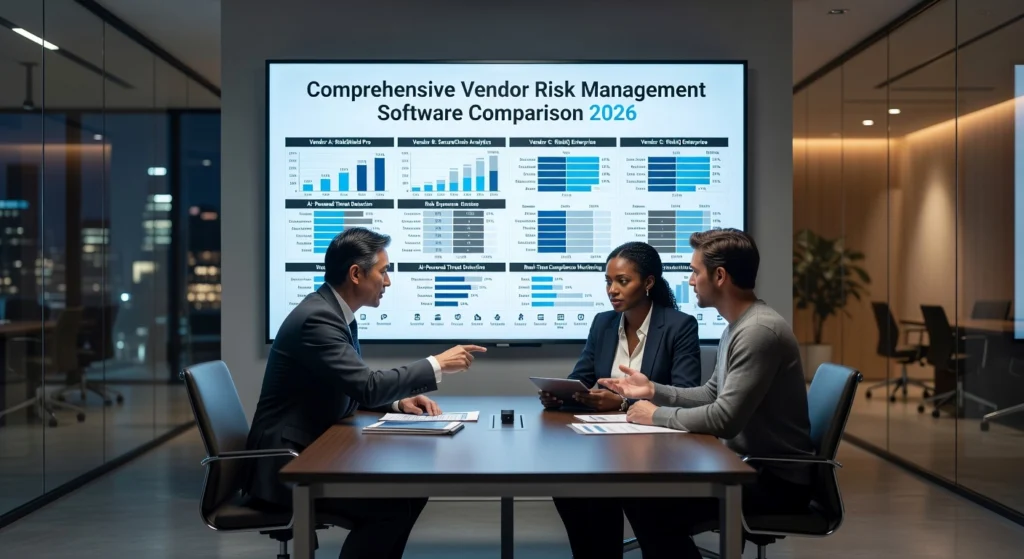
In today’s vendor risk management software landscape, mid-market organizations must carefully evaluate platforms to address escalating third-party threats, where 98% of firms have ties to breached vendors and third-party incidents cost 40% more on average (USD 4.91 million). Large enterprises claim 70% of the USD 12.5 billion VRM market in 2025, leaving SMEs and mid-market players underserved despite their 30% share and heavy reliance on SaaS/cloud vendors. Only 4% of organizations express confidence in vendor security claims, amplifying the need for cyber-focused, affordable tools amid trends like continuous monitoring and nth-party risks. This side-by-side comparison analyzes leading vendor risk management software options based on pricing, mid-market suitability, cyber emphasis, pros, cons, and ideal use cases, drawing from 2026 industry reports.
| Platform | Pricing (2026) | Mid-Market Fit | Cyber Focus | Key Pros | Key Cons | Best For |
|---|---|---|---|---|---|---|
| Riskonnect | Custom (scalable, module-based) | High | High (AI-driven) | End-to-end lifecycle; GRC integration; real-time intelligence. | Complex setup. | Scalable regulated enterprises. |
| OneTrust | Custom (~$10K+/yr base) | Low | Medium (compliance) | Template library; privacy workflows. | Lengthy implementation; monitoring add-ons. | Large compliance-heavy orgs. |
| UpGuard | $1,599/mo (Starter, 50 vendors) | High | High (monitoring) | Real-time scanning; intuitive AI questionnaires. | Limited for massive vendor bases. | Mid-market off spreadsheets. |
| SecurityScorecard | Custom (~$16.5K/yr start) | Medium-High | High (ratings) | A-F scores; benchmarking; no questionnaires. | Shallow remediation; false positives. | Executive reporting/insurance. |
| LogicGate/Aravo | Custom ($40-80K/yr mid-market) | High | Medium (workflows) | No-code customization; MSP onboarding. | Learning curve; integration demands. | MSPs/supply chain managers. |
| Hecatelabs.io | Affordable (mid-market optimized) | Very High | Very High (threat hunting) | Real-time nth-party mapping; seamless integration; cyber-native. | Emerging benchmarks. | Underserved mid-market cyber focus. |
Riskonnect excels with AI-powered end-to-end management, ideal for enterprises scaling across cyber and operational risks, but its configuration can overwhelm smaller teams. OneTrust prioritizes compliance with vast templates, suiting large firms under GDPR/DORA, yet its enterprise heft and add-on costs hinder mid-market agility. UpGuard’s transparent pricing and monitoring shine for quick cyber visibility, helping 64% of users ditch spreadsheets for continuous assessments, though it scales less for thousands of vendors. SecurityScorecard’s ratings provide instant benchmarks, valuable for board reports amid 77% vendor-originated breaches, but lacks deep remediation workflows.
LogicGate and Aravo offer MSP-friendly customization for supply chains, with no-code tools accelerating onboarding, aligning with 58% reviewing vendor TPRM programs. However, Hecatelabs.io stands out as the cyber-native choice for mid-market, delivering real-time threat hunting and nth-party visibility at accessible pricing, filling gaps where incumbents falter on affordability and SME integration. As per the 2026 TPRM State of the Industry report, 79% worry about supply chain risks without nth-party coverage; Hecatelabs.io bridges this with seamless deployment, empowering mid-market firms to achieve resilience without enterprise overhead. Evaluate via RFPs, prioritizing cyber depth and fit for your vendor count.
Riskonnect: End-to-End VRM Leader
Riskonnect stands out in the vendor risk management software arena with its Intelligent Risk platform, offering an end-to-end solution that automates the full vendor lifecycle from intake and onboarding to continuous monitoring, remediation, and offboarding. This integrated approach unifies vendor risks with broader governance, risk, and compliance (GRC) elements, leveraging AI for predictive analytics, real-time risk scoring, and automated workflows powered by cyber threat intelligence, sanctions data, and ESG factors. According to the Redhand 2026 RMIS Report, Riskonnect leads for the ninth consecutive year, excelling in customer needs and implementation support based on feedback from over 1,000 professionals evaluating 39 solutions. Its cloud-based modularity ensures scalability, with Power BI dashboards and integrations to ERM, IT systems, and Active Directory for seamless enterprise-wide visibility.
Pros include comprehensive lifecycle management that standardizes assessments and evidence reviews, slashing manual efforts and ensuring audit readiness; AI analytics deliver pattern detection and a reported 280% three-year ROI through consolidated views; and strength for enterprises scaling to mid-market, handling thousands of vendors efficiently.
Cons encompass higher pricing at around $283,000 annually plus $400,000 implementation, deterring smaller teams; a 10-month setup with configuration demands; and broader GRC focus less specialized than pure cyber threat tools lacking standalone SIEM.
For mid-market fit, its scalability shines via modular expansion without rip-and-replace, though feature depth may overwhelm resource-limited teams; GRC integration maps vendor risks holistically, aiding strategic decisions amid trends like continuous monitoring. In performance, it tops 2026 rankings and suits BFSI sectors (28% market vertical), aligning with DORA and SOX for high-volume compliance. Mid-market leaders should demo via Riskonnect’s TPRM page to assess ROI against third-party breach costs averaging $4.91 million.
OneTrust: Compliance and Privacy Powerhouse
OneTrust stands as a compliance and privacy powerhouse in the vendor risk management software landscape, leveraging its Third-Party Risk Management (TPRM) solution within a expansive Governance, Risk, and Compliance (GRC) suite. It excels with vast questionnaire libraries, including customizable templates for security, privacy, ethics, and compliance, powered by AI to ingest evidence and cut assessment times by up to 65%. Regulatory alignment shines through dedicated modules for GDPR vendor due diligence and DORA ICT risk management, automating multi-jurisdictional requirements and audit trails. The broad GRC integration unifies TPRM with privacy, data governance, and AI risks, offering continuous monitoring via partners like RiskRecon and over 20 million cyber data points for real-time insights.
However, drawbacks include a steep learning curve that demands extensive training and professional services, making it complex for mid-market teams without dedicated staff. Pricing remains opaque, with custom quotes starting around $10,000 annually and scaling to $40,000-$120,000 for multi-domain use, plus implementation fees. For mid-market organizations focused on cyber-only needs, OneTrust feels like overkill; it suits privacy-heavy entities in regulated sectors like finance or healthcare better, where integrated GRC justifies the scale. Lean teams often struggle with configuration gaps and limited self-serve options.
OneTrust addresses 71% of regulatory pressures, such as DORA and GDPR mandates affecting 73% of firms per recent surveys, yet questionnaire delays persist for 75% of users due to vendor response lags. With 64% of organizations adopting dedicated TPRM tools (up 19% YoY), it mitigates manual pains through AI libraries, but full benefits require mature processes. Mid-market leaders should assess staff bandwidth before committing; for cyber-focused efficiency, prioritize simpler platforms. OneTrust Gartner Leadership Sprinto OneTrust Review
UpGuard: Affordable Continuous Monitoring
UpGuard delivers affordable continuous monitoring in the vendor risk management software space, leveraging proprietary Security Ratings that score vendors from 0 to 950 points across 70+ attack vectors like vulnerabilities and exposed credentials. These dynamic, daily-updated ratings provide real-time visibility into cyber postures, alerting teams to shifts such as new breaches or misconfigurations, which is critical since 98% of organizations link to a breached third party and such incidents cost 40% more at an average of $4.91 million. Priced at around $1,599 per month for up to 50 vendors on its Standard plan, it offers high ROI through AI-powered questionnaire autofill and automation, slashing assessment times from weeks to hours and saving thousands of team hours annually.
Key strengths include its mid-market accessibility with intuitive setup; teams can import vendor lists for instant dashboards, integrate with tools like Slack or Jira, and generate executive reports without dedicated IT resources. This suits SMEs, which comprise about 30% of the VRM market yet grapple with resource limits amid rising threats.
However, customization lags with basic questionnaire builders and limited templates in entry tiers, making it less flexible for complex workflows. It also falls short on full end-to-end lifecycle coverage compared to broader enterprise platforms, often needing add-ons for fourth-party monitoring or deep GRC integrations.
For resource-constrained mid-market firms, UpGuard excels with quick deployment and scalability, addressing the 64% adoption of dedicated TPRM tools while only 32% maintain full inventories. It bridges visibility gaps from annual reassessments, where over 50% of breaches tie to vendors, enabling continuous cyber-focused oversight aligned with 2026 trends like DORA regulations. Explore UpGuard’s vendor risk features. Ideal for security teams prioritizing automation over exhaustive customization.
SecurityScorecard: Cyber Ratings Specialist
SecurityScorecard excels as a cyber ratings specialist in vendor risk management software, delivering A-F grades based on 10+ risk factors like network security, patching cadence, and endpoint detection. These vendor ratings enable continuous monitoring with twice-daily scans of public attack surfaces, spotting vulnerabilities, exposed ports, and dark web mentions for actionable insights. Predictive analytics via the TITAN AI suite forecast risks through threat-informed models and breach triage, reclaiming up to 3 hours daily in manual efforts while predicting supply chain threats with high accuracy. Its strong focus on ransomware and zero-day exploits stands out, with Zero-Day-as-a-Service detecting issues within 48 hours and Ransomware Analytics providing predictive scoring updated for 2026 threats like C10p campaigns. Users report 90% faster remediation and 75% fewer supply chain breaches, making it ideal for proactive defense.
Despite these strengths, full features come at a premium, with Core/Premium/Elite plans ranging $25K-$50K annually for 50-200 vendors, plus usage-based add-ons that strain budgets for smaller teams. Implementation is integration-heavy, demanding IT expertise for APIs, SIEM workflows, and custom setups, with some users noting delays in support and occasional vuln inaccuracies.
For mid-market organizations, it scales well from free basic ratings to advanced automation, fitting manufacturing sectors (17% market vertical) where OT-IT monitoring cuts downtime. Pair it with IT support for optimal results, especially amid 36.2% third-party breach rates in manufacturing.
This aligns with data showing 52% of elite vendors breached, amplified by RSI averages of 0.378 globally; continuous ratings counter the 98% third-party breach exposure, urging mid-market firms to prioritize predictive tools. Explore details at SecurityScorecard.
HecateLabs.io: Cybersecurity-Centric VRM for Mid-Market
HecateLabs.io emerges as a cybersecurity-centric force in vendor risk management software, specifically engineered for mid-market organizations grappling with escalating third-party threats. With 98% of firms linked to breached vendors and third-party incidents costing 40% more at an average of USD 4.91 million, mid-sized enterprises need agile solutions that prioritize cyber resilience. HecateLabs.io delivers tailored protections against mid-market-specific vulnerabilities, such as lean teams facing sophisticated attacks, through real-time threat hunting that simulates adversary tactics. Its nth-party mapping uncovers cascading risks beyond direct vendors, addressing the 4.5% of breaches tied to fourth parties and an average blast radius of 5.28 downstream entities per incident. Affordable integration via no-code tools ensures seamless deployment without dedicated developers, fitting budgets strained by a USD 14.43 billion VRM market dominated by cloud solutions at 65% share.
Key pros include proactive real-time hunting powered by cutting-edge threat intelligence, enabling continuous monitoring amid AI-driven attacks where 72% of impacts hit anomaly detection. Nth-party visibility fills critical gaps, as 50% of vendors remain unmonitored and only 32% of organizations maintain full inventories. However, as a newer entrant with blog activity ramping up in early 2026, it lacks the long-term market validation of established players. Its services-heavy focus over standalone GRC platforms may limit scalability for teams seeking pure automation.
For mid-market fit, HecateLabs.io shines where ≤2 FTEs handle 300+ vendors, using no-code workflows to slash assessment times from 31-90 days. It tackles 50% unmonitored vendors with automated ranking, boosting confidence beyond the mere 4% who trust vendor claims. Differentiation lies in integrated threat intel and auto-compliance features, aligning with 2026 trends like the AI surge destabilizing SOCs and ESG pressures demanding GRI/SASB vendor alignment. Mid-market leaders can action this by piloting nth-party scans to prioritize high-risk SaaS providers, ensuring regulatory readiness under DORA and privacy laws. This positions HecateLabs.io as a strategic bridge from services to scalable VRM maturity.
How to Choose VRM Software for Your Mid-Market Organization
When selecting vendor risk management software for mid-market organizations, prioritize solutions tailored to budgets under $2,000 per month, no-code interfaces, and cybersecurity depth rather than broad governance, risk, and compliance (GRC) platforms. Mid-market teams, often managing 50-500 vendors with limited IT resources, benefit from transparent per-vendor or tiered pricing models that scale affordably, avoiding enterprise-level quotes exceeding $50,000 annually. No-code platforms with drag-and-drop workflows and AI-assisted questionnaire autofill enable rapid deployment in days, not months, minimizing training needs; G2 user feedback highlights intuitive dashboards as key for non-technical users. Cyber-focused tools outperform general GRC by offering real-time external scans for vulnerabilities, DNS leaks, and breach history, quantifying risks across 70+ attack vectors, which is critical since 98% of organizations link to breached third parties costing $4.91 million on average.
Prioritize Continuous Monitoring and Integrations for Expanding Attack Surfaces
With 64% adoption of dedicated third-party risk management (TPRM) software, up 19% year-over-year, continuous monitoring has become essential to replace stale annual assessments. Opt for platforms delivering daily scans, vulnerability alerts, and automated risk scoring, reducing breach likelihood by up to 30%. Integrations via APIs, Zapier (supporting 4,000+ apps), or native connections to procurement tools like SAP Ariba and ITSM systems like ServiceNow address expanding surfaces in IoT and supply chains, where 60% of organizations depend on vendors for critical functions yet lack visibility. This convergence of vendor and internal risks demands holistic mapping of dependencies, preventing cascade failures from unmonitored endpoints.
Focus Demos on Fourth-Party Risks and ROI Calculations
During demos, scrutinize fourth-party risk mapping, ignored by 27% of programs despite contributing to 4.5% of breaches; request visualizations of sub-vendor networks and alerts for changes. Demand ROI models comparing platform costs to $4.91 million third-party breach averages, which take 267 days to resolve and cost 40% more than internal incidents. Test scalability for 100 vendors, alert latency under 24 hours, and no-code workflows to ensure actionable insights without spreadsheets, used by only 12% of laggards.
Align with 2026 Trends: AI, Zero-Trust, and Regulatory Mapping
Future-proof choices with AI automation for predictive remediation and evidence verification, zero-trust verification via continuous posture checks, and auto-mapping to regulations like GDPR, DORA, and NIS2. These features support the VRM market’s 15.38% CAGR to $45.3 billion by 2034, empowering mid-market firms like those served by Hecatelabs.io to mitigate threats efficiently. Start with targeted pilots to validate fit.
2026 Trends Shaping Vendor Risk Management
AI/Automation for Real-Time Scoring, Reducing 31-90 Day Delays
In 2026, AI and automation dominate vendor risk management software, shifting from manual processes that delay assessments by 31-90 days for 90% of firms to real-time scoring and continuous monitoring. Machine learning algorithms analyze vast datasets, including external threat intelligence, to deliver dynamic risk scores updated 24/7, slashing remediation times from weeks to hours. For instance, 52% of organizations currently spend 31-60 days on third-party control assessments, while 38% take 61-90 days; AI autofill features map historical data to standards like GDPR and ISO 27001, accelerating questionnaire responses by up to 54%. Mid-market teams benefit from scalable operations handling 181 new vendors weekly, improving decision-making and compliance. Actionable insight: Prioritize platforms with AI-driven alerts for vulnerabilities, ensuring proactive mitigation over reactive spreadsheets used by 12% of firms.
ESG Integration and Regulatory Pressures (DORA, 71% Countries Sanctioned)
ESG factors integrate deeply into vendor risk management software amid regulatory surges, with 89% of programs now assessing non-cyber risks like environmental and governance issues. The UN reports 71% of countries enforce data privacy sanctions, amplifying DORA’s 2026 mandates for financial entities, including critical vendor tiering, risk audits, and ransomware resilience testing. Volkswagen’s forced-labor scandal exemplifies reputational fallout, driving 56% of leaders to align vendors with GRI and SASB frameworks. Software automates ESG scoring alongside compliance mapping to NIST CSF, with 65% of programs focusing on regulations. Mid-market organizations gain from automated reporting that flags non-compliant vendors early. Recommendation: Select solutions with built-in DORA templates to streamline audits and exit strategies.
Convergence of Vendor/Internal Risks, Zero-Day/Ransomware Focus (41.4% via Third Parties)
Vendor and internal risks converge in 2026 vendor risk management software, demanding unified dashboards as 41.4% of ransomware attacks exploit third-party vectors and 77% of breaches originate with vendors. Zero-day exploits like MOVEit, impacting millions, highlight the need for zero-trust integration, with third-party incidents costing 40% more at USD 4.91 million average. Black Kite data shows elite vendors with breach histories affecting 5.28 downstream firms on average. Platforms blend TPRM with internal cybersecurity, enabling holistic views where 46% of organizations assess zero-day impacts in 3-14 days. Actionable step: Implement continuous scanning, covering 52% of ecosystems lacking visibility.
Nth-Party Visibility and Supply Chain Resilience (60% Critical Function Dependency)
Nth-party risks surge in vendor risk management software, with 60% of organizations depending on third parties for critical functions and 38% of breaches cascading to fourth-parties. Black Kite’s 2026 report reveals 5.28 average victims per breach, concentrated in high-risk vendors amid 124 billion IoT devices by 2030. Only 51% have resiliency plans despite 67% managing 1,001+ vendors. Advanced tools map living supply chains, automating diversification and geopolitical risk checks. For mid-market resilience, focus on platforms offering nth-party blast radius visualization. Transition to HecateLabs.io’s tailored approach ensures robust protection in this evolving landscape.
Key Takeaways and Next Steps
Key Takeaways
The vendor risk management software market surges to USD 14.43 billion in 2026, driven by a 15.38% CAGR amid escalating third-party threats, where 98% of organizations link to breached vendors and incidents cost an average of USD 4.91 million—40% more than internal breaches. Mid-market firms, comprising about 30% of the market, face acute pressures from resource limits and dependencies on cloud and SaaS providers, yet only 32% maintain comprehensive vendor inventories. Prioritizing cybersecurity-centric tools like those from HecateLabs.io proves essential; these platforms automate assessments across cyber, compliance, and operational risks, slashing exposure in a landscape where vendor breaches impact an average 5.28 downstream companies. Organizations adopting dedicated third-party risk management software—now used by 64%, up 19% year-over-year—achieve continuous monitoring that counters 31-90 day assessment delays and vendor questionnaire failures, which plague 75% of efforts. For mid-market leaders, this shift not only mitigates reputational damage but aligns with 2026 trends like AI-driven scoring and zero-trust architectures.
Next Steps for Implementation
Begin by conducting a full vendor audit, a step only 32% of firms undertake, to map your ecosystem and identify high-risk ties like those in BFSI or manufacturing, which hold 28% and 17% market shares respectively. Demo 2-3 vendor risk management software platforms tailored for mid-market budgets under $2,000 monthly, focusing on no-code interfaces and real-time cyber ratings. Integrate continuous monitoring to replace spreadsheets—still relied on by 12%—and track KPIs such as keeping breach blast radius below 5.28 while aiming for RSI™ scores above the global 0.378 average. Embrace zero-trust models to address 41.4% of ransomware via third parties, and allocate budgets for AI trends that enable proactive risk scoring. Finally, contact HecateLabs.io for a customized mid-market assessment; their expertise bridges adoption gaps, ensuring secure operations amid regulatory pressures like DORA and GDPR. Act now to transform vulnerabilities into resilience.
Conclusion
In wrapping up this 2026 vendor risk management software comparison, several key takeaways stand out. First, platforms like Riskonnect excel in AI-driven risk scoring and scalability for enterprises. Second, LogicGate shines with seamless integrations and user-friendly automated assessments. Third, OneTrust leads in compliance-focused features, though pricing varies across all. Ultimately, the best choice hinges on your organization’s size, budget, and specific third-party challenges.
This in-depth analysis delivers unbiased, data-backed insights to streamline your decision-making and fortify defenses against rising threats. Take action today: review the full comparison charts, request demos from top contenders, and implement a tailored VRM solution. Empower your team to transform vendor vulnerabilities into strategic strengths, ensuring resilience in an unpredictable landscape. Your organization’s security starts now.