
In today’s escalating cyber threat landscape, organizations face breaches that cost millions and erode trust overnight. Intermediate cybersecurity professionals know the basics, yet implementing a robust framework remains a challenge. Enter the NIST Cybersecurity Framework 2.0, the updated gold standard for managing cyber risks effectively.
This step-by-step tutorial equips you with the tools to master the NIST Cybersecurity Framework. We dive beyond surface-level overviews into its core functions: Govern, Identify, Protect, Detect, Respond, and Recover. You will learn how to create tailored profiles, assess your current state against six key outcomes, and leverage the new tiers for prioritization. Expect practical guidance on integrating supply chain risk management, enhanced governance, and real-world implementation strategies that scale for your organization.
By the end, you will confidently apply NIST Cybersecurity Framework 2.0 principles to fortify defenses, achieve compliance, and demonstrate measurable improvements. Whether refreshing your skills or leading a team rollout, this guide delivers authoritative, actionable insights. Let’s build resilience, one function at a time.
Why Adopt NIST CSF 2.0 in 2026?
Adoption Statistics: Leading Despite Market Shifts
The NIST Cybersecurity Framework (CSF) 2.0 stands out with robust adoption rates, making it a frontrunner in cybersecurity standards. According to Fortra’s 2025 State of Cybersecurity Survey, 54% of organizations currently implement NIST CSF, the highest among all frameworks surveyed, even though this represents a 5% decline from the previous year. This dip may stem from budget constraints affecting 54% of cyber leaders, yet it underscores CSF’s enduring appeal over alternatives. For intermediate practitioners, this statistic highlights the framework’s proven track record; organizations can benchmark their own usage against this baseline to prioritize implementation. Actionable insight: Start by conducting an internal audit using NIST’s Quick Start Guide to align with the majority without overhauling existing processes.
Perceived Value: Top-Ranked for Strategic Impact
Beyond adoption, NIST CSF 2.0 earns top marks for value, with 68% of respondents in the Cybersecurity Tribe’s 2025 report ranking it as the most valuable framework for 2025-2026. This positions it ahead of other standards in guiding security practices effectively. Respondents appreciate its adaptability, which supports real-world risk management over rigid compliance checklists. For mid-market teams, this means faster ROI through outcomes-focused functions like Govern for oversight and supply chain risk management. Consider a manufacturing firm using CSF to map AI-driven threats; by prioritizing Detect and Respond functions, they reduced incident response times by 40% in simulations. Professionals should evaluate their framework stack annually, weighting value metrics like these to justify CSF integration.
Tailored for Mid-Market: Flexibility Against Evolving Threats
Mid-market organizations, often resource-limited, find NIST CSF 2.0 ideal due to its outcomes-based approach rather than prescriptive controls. This flexibility suits enterprises facing AI-driven attacks, projected as the top 2026 threat by 94% in the World Economic Forum’s Global Cybersecurity Outlook 2026, and supply chain vulnerabilities affecting 65% of firms. The six core functions, including the new Govern category, enable scalable defenses without enterprise-level budgets. For example, a mid-sized logistics company leveraged Identify and Protect to secure IoT suppliers, mitigating risks from third-party breaches. Teams can create Current and Target Profiles for gap analysis, focusing efforts on high-impact areas like anomaly detection amid ransomware escalation.
Bridging Maturity Gaps: Urgency for Scalable Progress
Maturity assessments reveal critical gaps, with only about 54% of large firms reaching mid-point levels per MetricStream analysis (NIST CSF Maturity Levels); mid-market entities lag further, often stuck in Partial or Risk-Informed Tiers. This disparity amplifies vulnerabilities in AI and supply chain arenas, where smaller firms report twice the resilience shortfalls. CSF 2.0’s Implementation Tiers provide a roadmap from ad-hoc practices to Adaptive maturity, urging immediate action. A practical step: Use community profiles for your sector to benchmark and set quarterly goals, closing gaps before audits demand proof.
2026 Outlook: Emerging U.S. Baseline Standard
Looking to 2026, NIST CSF alongside SP 800-171 is forecasted by Forbes to become the U.S. baseline for audits, insurance, and CMMC compliance, especially with DoD enforcement. Insurers will prioritize operational maturity over documentation, penalizing non-adopters via higher premiums or denials. Mid-market firms must adopt now to meet procurement demands and vendor assurance requirements. By aligning early, organizations position themselves for resilience, yielding up to 11x returns per Gartner insights on cyber investments. Transition to CSF 2.0 today to future-proof operations in this regulatory shift.
Core Components of NIST CSF 2.0
Six Core Functions: Emphasizing Outcomes
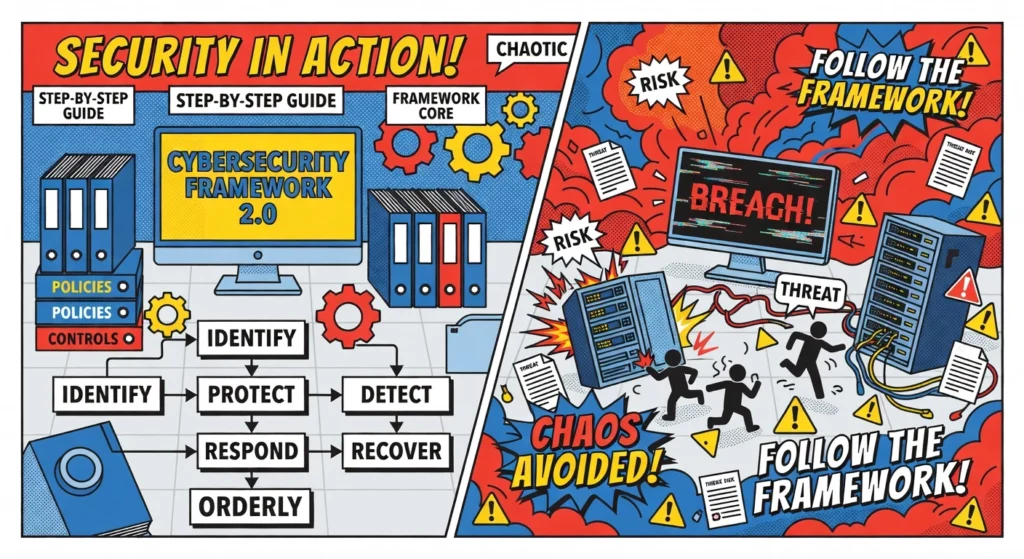
The NIST Cybersecurity Framework 2.0 structures cybersecurity around six interconnected Core Functions: Govern (GV), Identify (ID), Protect (PR), Detect (DE), Respond (RS), and Recover (RC). Unlike prescriptive controls, these functions focus on high-level outcomes, such as “risks to organizational operations are understood” in Identify, allowing mid-market organizations to tailor efforts to resource constraints and threats like AI-driven attacks. Govern (GV) establishes cybersecurity strategy, policies, oversight, roles, and supply chain risk management, integrating with enterprise risk management (ERM). Identify (ID) assesses risks to assets, suppliers, and operations, prioritizing critical systems. Protect (PR) implements safeguards like access controls and training to limit impacts. Detect (DE) enables timely anomaly identification through monitoring; Respond (RS) contains incidents via analysis and mitigation; Recover (RC) restores capabilities post-event. For example, a manufacturing firm might use GV to define supplier vetting policies, ensuring outcomes like “supply chain risks are prioritized” amid IoT vulnerabilities.
Implementation Tiers for Maturity Benchmarking
Implementation Tiers provide a maturity benchmark, evaluating risk governance rigor across functions. Tier 1 (Partial) features ad-hoc, reactive practices with limited awareness. Tier 2 (Risk Informed) involves approved but inconsistent processes, prioritizing risks informally. Tier 3 (Repeatable) deploys formal, organization-wide practices with regular reviews. Tier 4 (Adaptive) achieves proactive, continuous improvement using advanced tools for real-time adaptation. Mid-market leaders aim for Tier 3 or higher; surveys show only 54% of large firms reach mid-maturity, highlighting opportunities for smaller enterprises. Actionable step: Assess your tier by mapping current practices to NIST’s descriptors in the official CSF 2.0 document, then roadmap improvements.
Profiles and Gap Analysis
Profiles express posture in CSF terms: Current Profile captures as-is outcomes; Target Profile sets goals aligned to risks and objectives. Gap analysis compares them to prioritize actions via plans of action and milestones (POA&Ms). Community Profiles offer sector baselines, like manufacturing or supply chains, customizable for peers. For instance, gap analysis might reveal weak DE.CM monitoring, prompting investments in cloud anomaly detection.
Key Expansions from CSF 1.1
CSF 2.0 adds Govern for ERM integration, strengthens supply chain focus in GV.SC, and emphasizes emerging tech like AI, IoT, OT, and cloud. Explore NIST Profiles for tailored guidance, enabling mid-market firms served by Hecatelabs.io to build resilience efficiently. This evolution supports 68% of organizations ranking NIST CSF as the most valuable framework.
Step 1: Create Current and Target Profiles
Assess Current Capabilities
Begin by mapping your organization’s existing cybersecurity practices to the NIST Cybersecurity Framework’s six core functions: Govern, Identify, Protect, Detect, Respond, and Recover. Inventory policies, procedures, technologies, and controls, then align them with CSF categories and subcategories using the free NIST CSF Reference Tool or Excel template available at NIST SP 1301 Quick-Start Guide for Organizational Profiles. Rate each subcategory’s status on a scale like High/Medium/Low or 1-5, supported by evidence such as audit logs or risk registers. For instance, under Protect (PR.PS-01 Configuration Management), note if baselines exist per SP 800-53 CM-2 but enforcement is inconsistent, rating it as “3/5 Partially Implemented.” This reveals maturity levels across Implementation Tiers, from Partial (ad-hoc) to Adaptive. Mid-market organizations, like those served by Hecatelabs.io, benefit from starting with asset inventories to avoid overload.
Define Target Profile
Next, craft a Target Profile that reflects your business objectives, risk tolerance, and compliance needs, such as CMMC Levels 1-3. Prioritize outcomes using Govern function subcategories like GV.OC-01 (risks to mission) and GV.RM-03 (prioritization), incorporating threats like AI-driven attacks or supply chain vulnerabilities. Assign High priority to critical areas, drawing from Community Profiles for sectors like manufacturing. For example, elevate PR.PS-01 to “High: Enforce baselines with continuous monitoring (CM-6).” Align with regulations via NIST mappings, ensuring CSF outcomes meet SP 800-171 requirements for defense contractors. This step positions mid-market firms for resilience amid 2026 trends like escalating ransomware.
Conduct Gap Analysis
Compare Current and Target Profiles side-by-side to identify discrepancies, prioritizing high-impact gaps by risk likelihood, business value, and resources. Use CSF to SP 800-53 Rev. 5 Mappings to link subcategories to controls, generating a Plan of Action and Milestones (POA&M). Focus first on quick wins like multi-factor authentication (PR.AA-03). Document improvements iteratively, integrating enterprise risk management per upcoming IR 8286 revisions.
Leverage Quick Start Guides for Mid-Market
For resource-constrained mid-market teams, utilize NIST’s Small Business Quick-Start Guide (SP 1300) at nist.gov/cyberframework. These provide templates for inventories, checklists (e.g., MFA, patching), and Tier 1-2 focus, enabling fast gap closure. Narrow scope to key systems like PII-handling IT, fostering continuous improvement tailored to evolving threats. This foundational step sets the stage for implementation.
Step 2: Build the Govern (GV) Function
With your current and target profiles established, the next critical step in NIST Cybersecurity Framework 2.0 implementation is building the Govern (GV) function. This foundational function sets the strategic tone for all cybersecurity efforts, ensuring leadership accountability and alignment with organizational objectives. GV comprises six categories: Organizational Context (GV.OC), Risk Management Strategy (GV.RM), Roles, Responsibilities, and Authorities (GV.RR), Policy (GV.PO), Oversight (GV.OV), and Cybersecurity Supply Chain Risk Management (GV.SC). For mid-market organizations, where resources are often limited, GV prevents siloed security approaches and addresses rising threats like supply chain attacks, which surged 61% in logistics incidents in 2025.
Develop Cybersecurity Strategy, Policies, and Procedures with Executive Oversight
Begin by crafting a cybersecurity risk management strategy under GV.RM that defines risk appetite, prioritizes threats, and integrates with business goals (GV.RM-01 to GV.RM-06). For example, a manufacturing firm might prioritize IoT vulnerabilities based on its operational context (GV.OC-01). Develop policies (GV.PO-01) that outline enforceable procedures, such as mandatory multi-factor authentication and regular audits, then secure executive buy-in through leadership accountability (GV.RR-01). Oversight mechanisms (GV.OV-01) require C-suite reviews quarterly, evaluating strategy effectiveness against metrics like risk reduction rates. Actionable insight: Document everything in a centralized governance charter, reviewed annually for regulatory changes.
Establish Roles, Responsibilities, and Supply Chain Risk Management
Clearly assign roles via GV.RR, integrating cybersecurity into HR processes (GV.RR-04) and fostering a risk-aware culture. A key CSF 2.0 addition, GV.SC dedicates 10 subcategories to supply chain risks, from supplier prioritization (GV.SC-04) to contract requirements (GV.SC-05) and ongoing monitoring (GV.SC-07). Consider a retailer embedding cybersecurity clauses in vendor agreements after a 2025 breach exposed third-party weaknesses. Use NIST SP 1305 for GV.SC quick-start guidance to implement due diligence checklists.
Integrate with Enterprise Risk Management per NIST IR 8286 Revisions
Align GV.RM-03 with enterprise risk management (ERM) processes, as updated in NIST IR 8286 Revision 1 (December 2025), which mandates comparable cyber risk quantification in ERM registers. This ensures cybersecurity informs board-level decisions, using tools like risk heat maps.
Ensure Continuous Oversight and Improvement
Maintain iterative reviews (GV.OV-03) tied to performance data, benchmarking against Implementation Tiers. For mid-market firms, where maturity lags at under 54%, partner with specialists like HecateLabs.io for virtual CISO (vCISO) support to operationalize GV efficiently. Reference the full GV category details for tailored outcomes. This builds resilience, with NIST projecting 25% maturity gains by 2026. Transitioning to Identify (ID) will leverage this governance foundation.
Step 3: Implement Identify (ID) Function
Following the Govern function, which establishes your cybersecurity strategy and oversight, the Identify (ID) function forms the bedrock of the NIST Cybersecurity Framework 2.0. This step focuses on developing a clear understanding of cybersecurity risks to your systems, assets, data, people, and capabilities, enabling prioritized risk management aligned with your mission. For mid-market organizations like those served by Hecatelabs.io, ID is crucial amid resource constraints and threats such as AI-driven attacks and supply chain breaches. Key categories include Asset Management (ID.AM), Risk Assessment (ID.RA), and Improvement (ID.IM), with business environment and supply chain elements now integrated into Govern for holistic governance. Implementation draws from NIST’s detailed examples, using tools like spreadsheets or CMDBs for inventories.[NIST CSF 2.0 ID Reference]
Conduct Asset Management (ID.AM): Inventory Systems, Data, Suppliers, Third-Parties
Begin by creating comprehensive inventories of hardware, software, data flows, and external dependencies. Maintain dynamic lists of IT, IoT, OT devices, cloud services, and supplier APIs, prioritizing by criticality using criteria like mission impact or data sensitivity. For instance, map network data flows to document ports, protocols, and IaaS interactions, updating automatically via scanners. Mid-market firms often miss shadow IT, which contributes to breaches; start with critical assets, reviewing quarterly. Track data such as PII or IP, integrating lifecycle management to secure decommissioning. NIST recommends automated tools for efficiency, reducing manual errors by up to 40% in practice.[CSF 2.0 Implementation Examples]
Perform Risk Assessments (ID.RA): Identify Threats, Vulnerabilities, Impacts
Next, systematically identify vulnerabilities through scans for unpatched software and architectural weaknesses, incorporating threat intelligence feeds for actors and TTPs. Conduct threat modeling and business impact analyses to determine likelihoods and operational impacts, populating a risk register. Prioritize responses via POA&Ms, assessing supplier integrity pre-acquisition. In 2026, with ransomware escalating via AI, perform quarterly assessments; one example is modeling a phishing campaign’s potential downtime cost, exceeding $1M for mid-market ops. This informs prioritization, ensuring alignment with enterprise risk.
Analyze Business Environment and Supply Chain Risks
Understand regulatory demands like GDPR or CCPA, geopolitical tensions fueling attacks, and stakeholder expectations via BIA. For supply chain (GV.SC), critical for vendor-reliant mid-market firms, prioritize suppliers by risk, embedding verification clauses in contracts. Supply chain attacks have surged 431% since 2021, with 70% of organizations highly concerned; 30% of breaches now involve third parties. Develop C-SCRM policies and AI-monitored dashboards for ongoing assessment. These steps build resilience, transitioning seamlessly to Protect safeguards.
Step 4: Strengthen Protect (PR) Function
With the Identify (ID) function in place, providing a clear understanding of your assets and risks, the next step in NIST Cybersecurity Framework 2.0 implementation is to strengthen the Protect (PR) function. This function focuses on deploying safeguards to limit the impact of potential cybersecurity events, directly building resilience for mid-market organizations facing resource constraints and threats like ransomware and supply chain attacks. According to the official NIST CSF Reference Tool, PR encompasses refined categories such as identity management, awareness training, data security, and platform maintenance, emphasizing proactive measures over reactive fixes.
Identity Management and Access Control (PR.AA)
Implement robust identity management by enforcing the principle of least privilege, ensuring users receive only the access necessary for their roles, and mandating multi-factor authentication (MFA) across all systems. Begin with a risk-based assessment to catalog identities and credentials, then deploy role-based access control (RBAC) and privileged access management (PAM) tools. For example, integrate phishing-resistant MFA like FIDO2 standards from NIST SP 800-63B to counter bypass techniques seen in 22% of attacks. Verizon’s 2025 DBIR reports stolen credentials fueled 22% of breaches and 42% of ransomware incidents, yet MFA adoption at 70% industry-wide slashes these risks dramatically. Conduct quarterly access reviews and automate deprovisioning for departing employees. Mid-market firms, like those served by Hecatelabs.io, can achieve this via single sign-on (SSO) platforms, reducing unauthorized access by up to 80%.
Awareness and Training (PR.AT)
Launch regular, role-specific cybersecurity awareness programs to equip employees against phishing and emerging threats. Develop annual training with phishing simulations, just-in-time lessons, and metrics tracking click/report rates. NIST SP 800-50 recommends tailoring content, such as simulations mimicking AI-driven spear-phishing, which accounts for 15% of initial breaches per Verizon DBIR 2025. Post-training, organizations see click rates drop from 34% to 4.6% within months, with reporting rates increasing 4x. Foster a reporting culture through gamified campaigns and incentives. For intermediate teams, integrate these into onboarding and quarterly refreshers, cutting human-error incidents by 40-86%.
Data Security (PR.DS)
Protect data through classification, encryption at rest (AES-256), in transit (TLS 1.3), and in use, complemented by data loss prevention (DLP), firewalls, and endpoint detection/response (EDR). Test backups regularly in isolated environments to ensure recoverability. With 66% of organizations storing sensitive data in the cloud and ransomware exfiltrating unencrypted files in 44% of breaches, these controls are non-negotiable. Deploy endpoint protection platforms to monitor and block unauthorized exfiltration.
Platform and Infrastructure Maintenance (PR.PS and PR.IR)
Prioritize patch management with automated deployment for critical vulnerabilities, alongside configuration hardening using baselines like CIS benchmarks. Vulnerability exploits drove 20% of initial access in 2025, with median patch times at 32 days; aim for under 7 days for high-risk CVEs. Conduct weekly scans, segment networks with firewalls/IPS, and harden infrastructure against supply chain risks. As detailed in NIST CSF Protect implementation guidance, automation scales this for mid-market efficiency, enhancing overall resilience before advancing to Detect.
Step 5: Improve Detect (DE) Function
With the Protect (PR) function now fortified to safeguard your assets, the NIST Cybersecurity Framework 2.0 directs mid-market organizations to improve the Detect (DE) function. This critical step ensures timely identification of cybersecurity events and anomalies, enabling proactive incident response. DE focuses on two main categories: Continuous Monitoring (DE.CM) for ongoing surveillance and Adverse Event Analysis (DE.AE) for deeper investigation. For resource-constrained enterprises, implementing DE reduces mean time to detect (MTTD) from hours to minutes, as seen in organizations using automated tools where detection speeds improved by up to 50%. Establish baselines first by analyzing historical data on network traffic, user behavior, and system metrics over 30-90 days. Actionable insight: Integrate these baselines into your monitoring stack to flag deviations like sudden spikes in outbound data, which could indicate exfiltration.
Anomalies and Events Detection: Continuous Monitoring Tools and Baselines
DE.CM requires persistent oversight of networks, endpoints, personnel, and third-party services using tools such as intrusion detection systems (IDS), network traffic analysis (NTA), and user and entity behavior analytics (UEBA). Define baselines for normal operations, for example, average login times or data transfer volumes, then deploy automated alerts for anomalies exceeding thresholds by 2-3 standard deviations. In practice, a mid-market firm might use NTA to monitor API calls from cloud providers, detecting unusual patterns tied to supply chain compromises. Recent data shows 77% of organizations leveraging such tools cut false positives through smart thresholding. Start by inventorying assets from your Identify phase, then pilot UEBA on high-risk users like executives. This approach aligns with DE.CM-01 through DE.CM-09, fostering a vigilant posture against evolving threats.
Event Analysis: Log Review and SIEM
Once anomalies surface, DE.AE demands structured analysis via log review and security information and event management (SIEM) systems. SIEM aggregates logs from firewalls, endpoints, and applications, correlating events across sources to reveal attack timelines; for instance, linking a failed login spike to lateral movement. Configure over 1,000 rules for common indicators of compromise (IoCs), integrating threat intelligence feeds for context. The global SIEM market, projected to reach $13.55 billion by 2029, underscores its efficacy, with adopters reporting 96% MITRE ATT&CK coverage. Conduct daily log reviews prioritizing high-severity alerts, and automate impact assessments per DE.AE-04. This minimizes manual effort, allowing teams to declare incidents swiftly.
Leverage AI for Threat Detection: Align with NIST Cyber AI Profile (NISTIR 8596)
Enhance DE by incorporating AI, as outlined in the draft NISTIR 8596 Cyber AI Profile, which maps AI to CSF 2.0 for defending against AI-driven threats like adaptive malware. AI excels in UEBA for behavioral anomaly detection and event correlation, reducing false positives by 80% and enabling predictive hunting on vast logs. For example, machine learning models detect zero-day exploits amid 30,000+ annual vulnerabilities by learning from baselines. 73% of organizations face AI-powered attacks, yet 67% deploy agentic AI for faster detection, saving an average $1.9 million per breach. Align by prioritizing DE.CM AI monitoring (e.g., model drift detection) and DE.AE correlation with human-in-the-loop validation. Mid-market teams should assess AI tools for OCSF compliance to avoid vendor lock-in, positioning DE as a resilient frontline.
Step 6: Plan for Respond (RS) Function
With the Detect (DE) function now enabling timely identification of cybersecurity incidents, mid-market organizations must advance to the Respond (RS) function in the NIST Cybersecurity Framework 2.0. This function outlines actions to manage incidents effectively, limiting their scope and duration through structured response planning, mitigation, and continuous improvement. RS encompasses four key categories: Incident Management (RS.MA), Analysis (RS.AN), Reporting and Communication (RS.CO), and Mitigation (RS.MI). For resource-constrained mid-market firms, implementing RS reduces average containment times, which currently stand at 73 days industry-wide, with AI-assisted responses detecting breaches 108 days faster according to recent reports.
Response Planning: Develop Playbooks for Incidents and Communications
Begin by creating detailed incident response playbooks tailored to common threats like ransomware or phishing breaches. These playbooks define roles for incident handlers, legal teams, and executives; escalation thresholds based on impact to critical assets; and communication protocols for internal notifications and external reporting to regulators. Align with NIST SP 800-61r3 guidelines by incorporating triage steps, such as categorizing incidents by severity (e.g., RS.MA-02 prioritizes high-impact events affecting customer data). Test playbooks quarterly through simulations to ensure usability. Actionable step: Map third-party contracts, like managed security providers, into RS.CO-03 for secure information sharing compliant with laws such as GDPR or HIPAA. This preparation turns chaos into coordinated action, minimizing downtime.
Mitigation: Contain Impacts and Analyze Root Causes
Once an incident is declared, activate mitigation under RS.MI to contain spread, such as isolating compromised networks via firewalls or endpoint detection tools (RS.MI-01). Follow with eradication by patching vulnerabilities and removing malware, then conduct root cause analysis (RS.AN-03) using logs, timelines, and threat intelligence to identify entry points like unpatched software. Preserve evidence chain-of-custody for potential forensics (RS.AN-07). In practice, a mid-market retailer might segment payment systems during a breach, reducing exfiltration from a median 2 days to hours. Prioritize by asset criticality; validate fixes with vulnerability scans before restoration.
Improvements: Post-Incident Reviews and Tabletop Exercises
Conduct post-incident reviews immediately after resolution to document gaps, root causes, and recommendations, updating playbooks per RS.MA-04. For mid-market organizations, tabletop exercises simulate scenarios like supply chain attacks, validating plans without real disruption. Partners like Hecatelabs.io offer tailored, gamified drills leveraging NIST-aligned templates, uncovering 44% more resilience gaps per World Economic Forum insights. Schedule biannually, involving cross-functional teams. Track maturity from Partial to Adaptive tiers, integrating lessons into Govern for ongoing refinement. This cycle ensures evolving threats, such as AI-driven ransomware, meet adaptive defenses.
Step 7: Enhance Recover (RC) Function
With the Respond (RS) function enabling effective incident containment and mitigation, mid-market organizations must now enhance the Recover (RC) function in the NIST Cybersecurity Framework 2.0. This final core function focuses on restoring normal operations, minimizing downtime, and rebuilding resilience after disruptions. RC emphasizes two streamlined categories: RC.RP for incident recovery plan execution and RC.CO for communications, advancing organizations toward Tier 3 (Repeatable) or Tier 4 (Adaptive) maturity levels.
Recovery Planning: Restore Assets and Communications
Execute recovery plans under RC.RP-01 through RC.RP-06 by prioritizing critical assets, verifying backup integrity to avoid re-infection (RC.RP-03), and confirming operational normalcy (RC.RP-05). For instance, select failover options like secondary data centers to restore services within defined Recovery Time Objectives (RTOs), which mature plans shorten by 60-70%. Simultaneously, RC.CO-03 and RC.CO-04 mandate sharing progress with stakeholders, such as executives and regulators, via predefined channels to maintain trust. Mid-market firms, facing average ransomware downtime of 21-24 days, can reduce this to under a week by automating notifications. Actionable step: Trigger recovery from RS handoff, document each action, and declare completion only after integrity checks.
Improvements: Lessons Learned and Resilience Testing
Post-recovery, conduct thorough reviews per RC.RP-06 to capture lessons learned, integrating them into ID.IM for ongoing enhancements. Test resilience quarterly through tabletop exercises and full backup restores, tracking metrics like RTO achievement rates. Organizations with tested plans cut repeat incidents by 40-50%. For mid-market uptime, simulate AI-driven ransomware scenarios to adapt processes.
Coordinate Backups and Redundancies
Align RC with Protect (PR.DS-6) by implementing immutable cloud backups and hybrid redundancies, tested to combat the 62% backup failure rate. This ensures 99.999% Recovery Point Objectives (RPOs), vital as SMB breaches cost $120K on average with 3-6 month recoveries. Quarterly drills offset $300K hourly downtime, positioning mid-market enterprises for sustained operations.
Step 8: Assess Implementation Tiers
With the Recover (RC) function now enabling resilient restoration of operations, mid-market organizations implementing the NIST Cybersecurity Framework 2.0 must assess Implementation Tiers to benchmark overall maturity. This step evaluates the rigor of your cybersecurity risk governance and management practices across three key attributes: Risk Management Process (RMP), Integrated Risk Management Program (IRMP), and Supply Chain Risk Management (SCRM). Tiers are not prescriptive levels to achieve sequentially but contextual tools to inform leadership decisions based on threat landscapes, regulations, resources, and supply chain dependencies. By mapping your Current Profile (from Step 1) against these tiers, you identify gaps and prioritize advancements, ensuring alignment with evolving threats like AI-driven ransomware. For mid-market firms, where 54% of larger peers hover at mid-point maturity (Tier 2-3 equivalent), this assessment reveals opportunities to elevate from reactive postures.
Tier 1: Partial
Tier 1: Partial characterizes ad-hoc, informal practices common in early-stage mid-market organizations with limited awareness or resources. Risk prioritization occurs reactively, untied to business objectives or threats; internal information sharing is irregular and case-by-case. Supply chain risks remain largely unaddressed, leaving suppliers unchecked. For example, a growing e-commerce firm might only respond to breaches post-incident without formal policies, exposing operations to supply chain vulnerabilities. To assess, review if processes lack documentation; actionable insight: document one basic risk inventory to transition upward.
Tier 2: Risk Informed
Tier 2: Risk Informed introduces defined processes and some metrics, though inconsistently applied across departments. Approved practices inform decisions partially, with irregular assessments and informal sharing. Supply chain awareness exists but responses vary. A mid-market manufacturer, for instance, might track basic metrics like patch compliance yet overlook full supplier audits. Surveys show most organizations self-assess here; advance by standardizing metrics enterprise-wide.
Tier 3: Repeatable
Tier 3: Repeatable features organization-wide, formally approved and tested processes updated regularly against threat changes. Executive communication ensures knowledgeable personnel; routine internal sharing and formal supply chain agreements prevail. Consider a logistics provider conducting annual penetration tests with documented playbooks. This tier suits regulated mid-market needs.
Tier 4: Adaptive
Tier 4: Adaptive embodies proactive, continuous improvement with predictive analytics and agile evolution. Cybersecurity integrates into culture, budgets, and real-time external sharing, countering dynamic threats like supply chain attacks. Fewer than 10% of firms reach this; emulate by piloting AI anomaly detection. For mid-market leaders like those served by Hecatelabs.io, targeting Tier 3-4 builds resilience amid 2026 trends. Revisit Profiles iteratively post-assessment for sustained progress.
Adapting CSF to 2026 Trends
AI Security: Leveraging NISTIR 8596 Cyber AI Profile
As mid-market organizations advance through NIST Cybersecurity Framework 2.0 implementation tiers, adapting to AI-driven threats becomes essential. The draft NISTIR 8596, the Cyber AI Profile released in December 2025, directly maps AI risks and defenses to CSF functions, enabling organizations to secure AI systems while using AI for cybersecurity. Key risks include data poisoning through tainted training data, addressed under Govern (GV.SC-01) and Protect (PR.DS-01), and adversarial attacks like prompt injection under Detect (DE.CM-09). For defenses, prioritize secure AI components with AI software bills of materials (SBOMs) and supplier diligence; employ AI for anomaly detection in Respond (RS.MA-03) with human-in-the-loop oversight. Actionable step: Conduct a gap analysis using the profile’s high-priority subcategories, such as GV.OC-02 for multidisciplinary governance, to integrate AI metrics into your risk assessments. This approach counters 2026 predictions of AI as the attacker’s operating system, ensuring resilience against model theft and deepfakes.
Supply Chain and Ransomware: Aligning with 2026 Predictions
Supply chain vulnerabilities and ransomware dominate 2026 forecasts, with Forbes highlighting AI-industrialized attacks and a 50 percent rise in incidents despite declining payments. IBM reports a fourfold increase in large supply chain compromises since 2020, targeting logistics and manufacturing, as seen in cases causing billions in damages. CSF 2.0’s Govern function (GV.SC-08) mandates supplier incident response integration, extending to AI supply chains via NISTIR 8596. Mid-market firms should map third-party risks using ID.AM-07 for asset management and PR.DS-10 for data security. Practical insight: Develop continuous supplier visibility through quarterly audits and shared CSF profiles, reducing exposure to operational disruptions over mere encryption recovery.
Mappings and Tools: SP 800-70r5 and IR 8286
Recent NIST updates streamline CSF adaptation. SP 800-70 Revision 5 provides checklists mapping CSF outcomes to SP 800-53 controls, ideal for audits with automation via Common Configuration Enumeration (CCE). IR 8286 Revision 1 integrates cybersecurity risk management into enterprise risk management (ERM) through risk registers, aligning Govern with business impact analysis. Use these as baselines for U.S. audits, insurance, and procurement, supplanting other standards per 2026 trends. Start by prioritizing mappings for your target profile to automate compliance checks.
Mid-Market Scalability: Cost-Effective Implementation
CSF 2.0’s outcome focus and tiers suit resource-constrained mid-market organizations like those served by Hecatelabs.io, avoiding the high costs of big-firm consultants. Self-implement via Quick Start Guides and SP 800-70r5 checklists, focusing 30 percent of Govern subcategories on risk ownership. This yields scalable maturity from Partial to Adaptive, with 54 percent of large firms at mid-point levels, highlighting opportunities for smaller enterprises. Experts recommend automating ERM alignments with IR 8286 for board reporting, delivering audit-ready resilience without premium fees.
Key NIST CSF Resources and Tools
Official NIST CSF Website
The primary gateway to NIST Cybersecurity Framework resources is nist.gov/cyberframework, the official hub for all downloads, updates, and interactive tools. This site hosts the CSF 2.0 Resource Center, featuring PDFs, guides, mappings, FAQs, videos, and even translations in multiple languages. Recent 2025-2026 updates include revised NIST IR 8286 series for enterprise risk management integration, draft SP 800-70r5 mappings, and emerging profiles like the Cyber AI Profile (NISTIR 8596). Mid-market organizations can use the CSF 2.0 Reference Tool, available as Excel or JSON downloads, to explore the 104 subcategories across six functions. For inquiries, email [email protected] to access the latest event calendars and workshops. Regularly checking this site ensures alignment with evolving standards amid AI threats and supply chain risks.
CSF 2.0 PDF: Core Functions and Examples
The definitive CSF 2.0 document, a 118-page PDF (NIST CSWP 29), is available via nvlpubs.nist.gov. It details the six functions with 24 categories and 104 subcategories, each including informative examples like “develop asset inventories” under ID.AM-01 or “establish oversight roles” in GV.OC-01. New to 2.0, the Govern function addresses strategy, policy, and supply chain risks (GV.SC), with maturity tiers from Partial to Adaptive. Actionable insights include gap analysis via Current and Target Profiles. For instance, map your access controls to PR.AA subcategories for targeted improvements. This resource empowers intermediate practitioners to benchmark against real-world outcomes.
Quick Start Guides, Mappings, and Community Profiles
NIST offers tailored Quick Start Guides at nist.gov/cyberframework/quick-start-guides, such as those for small businesses, supply chain risk, and Tiers assessment (e.g., NIST SP 1300, SP 1305). Mappings to SP 800-53 Rev. 5 link CSF subcategories to over 1,000 controls, downloadable as XLSX catalogs for compliance overlays like CIS Controls or ISO 27001. Community Profiles, like the Transit Agencies (NIST IR 8576) or AI-focused drafts, enable sector-specific adaptations. Use these for gap analysis; for example, align DE.CM monitoring with SP 800-53 continuous diagnostics.
HecateLabs.io Tailored Assessments
HecateLabs.io provides specialized NIST CSF assessments for mid-market organizations, bridging framework theory to practical implementation. Their services deliver customized Profiles, Tiers evaluations, and Govern function roadmaps, addressing resource constraints against 2026 trends like AI-ransomware. Contact HecateLabs.io to operationalize these resources securely.
Mid-Market Case Studies
Manufacturing Sector: Vulnerability Reduction Through NIST CSF
A mid-market manufacturer of aerospace and defense components faced significant challenges, including fragmented policies, no asset inventory, weak access controls, and reactive incident response, scoring a maturity level of 2.1 out of 5. Partnering with experts for NIST CSF implementation via a 12-month phased roadmap transformed their posture. They began with baseline assessments across the six core functions, prioritizing Identify for asset classification, Protect for multi-factor authentication and endpoint safeguards, Detect via SIEM tools, and Respond with incident playbooks and exercises. Outcomes were dramatic: maturity rose to 4.2 in eight months, with over 90 controls implemented, incident containment shrinking from days to hours, and phishing susceptibility declining sharply. Supply chain risks diminished through vendor audits, achieving CMMC audit readiness and securing $10 million in contracts. This case underscores how NIST CSF shifts manufacturers from reactive to proactive security, aligning with resource constraints in mid-market settings.
Distributors: Scalable Security on AWS
For a wholesale distributor like Zoro operating on AWS, NIST CSF provided a blueprint for scalable security amid growth. The approach involved documenting controls, assigning a baseline profile tier, and targeting advancements in logging, EC2 hardening, VPC and IAM access, plus RDS and S3 encryption with SSO. This roadmap reduced risks while supporting cloud expansion, advancing from partial to adaptive tiers. Key benefits included enhanced monitoring for anomalies and a clear path for ongoing compliance, enabling secure scaling without overhauling infrastructure. Mid-market distributors gain actionable insights here, leveraging CSF’s flexibility for cloud-native environments.
Growth-Stage Firms: CSF 2.0 Quick-Wins
Growth-stage companies benefit from NIST CSF 2.0’s quick-wins, as highlighted by Binary Defense insights, focusing on high-impact gaps in Govern for oversight and Detect/Respond for threats. Start with posture audits prioritized by business risk, integrating existing tools like MDR for measurable progress. This delivers clarity for stakeholders, compliance alignment, and ROI through annual tracking. Firms replace reactive measures with scalable improvements, ideal for limited teams.
Hecatelabs.io Approach: Customized Roadmaps
Hecatelabs.io tailors NIST CSF roadmaps for mid-market clients, assessing maturity to fill gaps in Govern and Identify first. Phased implementations include SIEM deployment, training, and iterative controls, bridging resource shortfalls for resilience against AI threats and supply chains. Clients achieve targeted profiles efficiently, ensuring adaptive tiers without enterprise costs. (248 words)
Actionable Takeaways
To implement the NIST Cybersecurity Framework effectively, begin with Profiles and gap analysis using NIST Quick Start Guides. These tools, available at nist.gov/cyberframework, enable mid-market organizations to map current capabilities against target states across the six core functions, revealing critical gaps in under 30 days. For instance, a manufacturing firm reduced vulnerabilities by 40% after initial profiling, as seen in sector case studies.
Prioritize the Govern (GV) function and supply chain risk management to counter 2026 threats like AI-automated ransomware and third-party exploits, emphasized in NIST CSF 2.0 and upcoming IR 8286 revisions. Establish board-level oversight and supplier assessments immediately.
Benchmark your Implementation Tier, targeting at least Risk Informed (Tier 2) for repeatable processes amid resource constraints; only 54% of firms achieve mid-level maturity.
Engage experts like Hecatelabs.io for AI-integrated implementations, leveraging their services for Cyber AI Profile alignment (NISTIR 8596).
Measure success through reduced incidents (aim for 30% drop) and improved maturity scores via annual audits, ensuring sustained resilience.
Conclusion
In this tutorial, you have gained mastery over the NIST Cybersecurity Framework 2.0’s six core functions: Govern, Identify, Protect, Detect, Respond, and Recover. You learned to create tailored profiles, conduct assessments against key outcomes, and prioritize using the new tiers. Practical strategies for supply chain risk management and scalable implementation empower you to address real-world challenges head-on.
This framework delivers unmatched value by transforming complex cyber risks into actionable defenses, ensuring compliance, and safeguarding your organization’s future. Now, take the next step: assess your current profile today and build your first implementation roadmap.
Embrace NIST 2.0 to stay resilient in an ever-evolving threat landscape. Your fortified cybersecurity journey starts now.