
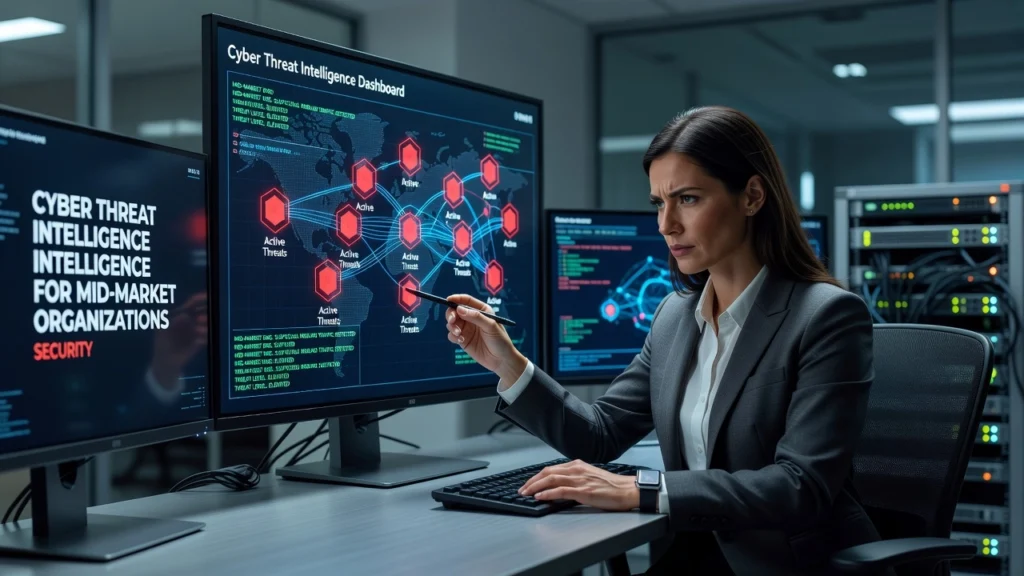
Cybercriminals do not discriminate by company size, yet mid-market organizations consistently find themselves caught in a difficult position. They face nearly the same volume and sophistication of attacks as enterprise-level corporations, but operate without the same budgets, staffing, or security infrastructure to defend against them. This gap is precisely where cyber threat intelligence becomes a critical advantage rather than a luxury reserved for large organizations.
Cyber threat intelligence transforms raw security data into actionable insights, giving your organization the ability to anticipate threats before they materialize rather than simply reacting after damage is done. For mid-market companies, implementing an effective intelligence program does not require an army of analysts or a Fortune 500 budget. It requires the right framework, the right data sources, and a clear understanding of your specific threat landscape.
In this analysis, we will break down how mid-market organizations can build and leverage a practical cyber threat intelligence capability. You will walk away understanding the core components of an effective program, the most relevant threat categories targeting your sector, and concrete steps to move from reactive security to an intelligence-driven defense posture.
What Is Cyber Threat Intelligence?
Cyber threat intelligence is the disciplined practice of collecting raw data about existing and emerging threats, processing that data through structured analysis, and converting it into actionable knowledge that drives proactive security decisions. The emphasis on “proactive” is not incidental. As ZeroFox articulates, simply knowing about threats is insufficient; that knowledge must be relevant, timely, and operationally usable before it qualifies as intelligence. CTI transforms noise into context, giving security teams the foresight to anticipate adversary behavior rather than merely respond to it after damage is done.
Understanding what CTI is not proves equally important, particularly for mid-market organizations navigating a crowded vendor landscape. Threat monitoring generates reactive alerts when predefined rules are triggered; it tells you something happened, not why or what comes next. SIEM platforms aggregate and correlate log data from across your environment, functioning as a forensic and detection layer rather than a forward-looking intelligence function. Vulnerability scanning inventories weaknesses in your own systems without contextualizing which of those weaknesses active adversaries are currently weaponizing. CTI operates upstream of all three, informing what to monitor, which vulnerabilities carry genuine urgency, and how attackers are likely to move once inside a network.
The intelligence cycle provides the operational framework that makes CTI repeatable rather than ad hoc. The five core stages are collection, processing, analysis, dissemination, and feedback. Collection gathers raw data from technical feeds, open-source intelligence, dark web sources, and telemetry. Processing normalizes and structures that data so it can be meaningfully analyzed, a step that is frequently underestimated by teams without dedicated analyst capacity. Analysis identifies adversary tactics, techniques, and procedures, along with intent and capability. Dissemination delivers finished intelligence to the right audience in the right format; executives require strategic briefs while SOC analysts need tactical indicators. Feedback closes the loop, allowing stakeholders to evaluate relevance and sharpen the next collection cycle. You can explore the threat intelligence lifecycle in detail via Recorded Future’s six-phase model, which provides additional granularity for teams building programs from the ground up.
CTI now sits at the core of mature cybersecurity programs rather than functioning as an optional add-on. With global cybercrime costs projected to climb from $9.22 trillion in 2024 to $13.82 trillion by 2028, and with adversaries deploying autonomous AI agents to automate reconnaissance and exploitation at scale, organizations that treat intelligence as peripheral are structurally disadvantaged. The cyber threat intelligence lifecycle framework outlined by SentinelOne reinforces this point, framing CTI as a continuous, embedded capability rather than a periodic exercise. For mid-market organizations without large security teams, a structured CTI program is not a luxury; it is the force multiplier that makes every other security investment more effective.
The Four Types of Cyber Threat Intelligence
Not all cyber threat intelligence serves the same purpose, and treating it as a single category is one of the most common mistakes resource-constrained security teams make. CTI is formally segmented into four distinct types, each designed for a different audience, operating at a different time horizon, and requiring a different consumption model. Understanding these distinctions is not academic; it directly determines whether your intelligence program reduces risk or simply generates more noise.
Strategic CTI
Strategic intelligence operates at the highest level of abstraction, designed for executives, board members, and CISOs who need to understand the broad threat landscape without getting lost in technical detail. This layer focuses on geopolitical developments, nation-state targeting patterns, industry-sector risk trends, and long-range business risk framing. As ZeroFox intelligence manager Daniel Curtis has noted, intelligence only becomes useful when it is processed for a specific target audience, and at the strategic level that audience is making investment and policy decisions, not blocking IP addresses. Strategic CTI typically arrives as written reports, threat landscape briefings, and risk assessments, providing the contextual foundation that makes every other intelligence type more meaningful.
Tactical CTI
Tactical intelligence maps adversary behavior to structured frameworks, with its primary output being a clear understanding of tactics, techniques, and procedures (TTPs). These are most commonly mapped against MITRE ATT&CK, giving security architects and detection engineers a durable blueprint for tuning defensive controls. The key advantage of TTPs over raw indicators is longevity; while a malicious IP address can be rotated within hours, a threat actor’s preferred lateral movement technique may persist unchanged for months or years. This makes tactical CTI significantly higher-signal over time, and particularly valuable for teams building detection rules that need to remain effective across multiple attack campaigns.
Operational CTI
Operational intelligence sits between the long-range view of strategic CTI and the raw data of the technical layer. It focuses on specific, active threat campaigns: who is behind them, which industries or geographies are being targeted, what the attack timeline looks like, and what indicators of compromise have been observed. This type is most directly actionable for incident response teams and SOC analysts who need to determine whether a threat is relevant to their organization right now. A practical example would be intelligence surfacing that a ransomware group is actively discussing exploitation of a vulnerability affecting a specific sector before an attack materializes.
Technical CTI
Technical intelligence is the most granular layer, comprising machine-readable data including IP addresses, file hashes, malicious domains, and YARA rules. According to Palo Alto Networks, this layer is consumed primarily by automated security tools, SIEMs, firewalls, and endpoint detection platforms rather than by human analysts performing deliberate analysis. Technical CTI has the shortest useful lifespan of any type, with IOCs becoming stale within hours as attackers rotate infrastructure.
Which CTI Types Matter Most for Mid-Market Organizations
For mid-market organizations with lean security teams, the temptation is to default to technical feeds because they are abundant, inexpensive, and feel immediately actionable. However, as Exabeam’s CTI analysis explains, effective intelligence programs require understanding which type of intelligence serves which decision. Ingesting bulk IOC feeds without knowing whether the associated threat actors even target your sector produces false urgency and alert fatigue, overwhelming analysts who are already stretched thin. Operational CTI arguably delivers the strongest return for resource-constrained teams; it is specific enough to be immediately actionable, yet contextual enough to filter out irrelevant noise. Tactical CTI is a strong secondary priority because detection rules built around TTPs compound in value over time. Strategic CTI ensures leadership can make informed investment decisions rather than reacting to every threat headline. Technical feeds, used in isolation without this broader context, generate volume rather than insight.
Why CTI Is No Longer Just an Enterprise Concern
The cyber threat intelligence market is projected to grow at a 22.1% CAGR, making it one of the fastest-expanding segments within the broader cybersecurity industry. That growth rate is not being driven exclusively by Fortune 500 security programs. Mordor Intelligence explicitly identifies SMEs and mid-market organizations as a key demand segment fueling this expansion, a signal that CTI adoption is undergoing a fundamental democratization. What was once a capability reserved for organizations with dedicated threat intelligence teams and seven-figure security budgets is now being actively adopted by firms operating with far leaner resources. The market trajectory reflects a structural shift in how organizations of all sizes are calculating risk, and the firms that interpret this shift as an enterprise-only trend are making a strategically dangerous assumption.
The Threat Actor Landscape Has Changed
The Canadian Centre for Cyber Security’s National Cyber Threat Assessment 2025-2026 delivers a clear and uncomfortable finding: state-sponsored adversaries are increasingly targeting mid-sized commercial organizations, not limiting their operations to government agencies or critical infrastructure operators. This represents a meaningful expansion of adversary targeting scope. Geopolitically motivated campaigns now extend into supply chains, financial services providers, and technology firms at the mid-market tier, because these organizations frequently serve as access vectors into higher-value targets or hold commercially sensitive data worth exfiltrating. The traditional assumption that nation-state actors have no interest in mid-market firms is no longer operationally defensible. Organizations in this segment must now model their threat environment with the same rigor previously applied only at the enterprise or government level.
AI Has Lowered the Barrier to Sophisticated Attacks
Ransomware-as-a-Service ecosystems have industrialized cybercrime by separating the development of attack tooling from its deployment, enabling low-skill operators to execute sophisticated intrusion chains at scale. The emergence of agentic AI tools has compounded this dynamic significantly. Adversaries can now deploy autonomous agents capable of conducting multi-stage attack workflows, including reconnaissance, credential harvesting, and lateral movement, with minimal human direction and at a fraction of historic operational costs. The practical consequence is that mid-market organizations now face threats in both sophistication and frequency that were previously concentrated among high-value enterprise targets. The barrier to entry for attackers has collapsed; the barrier to defense has not moved at the same rate, and that gap is precisely where mid-market organizations are most exposed.
Resourcing Asymmetry Makes Intelligence-Driven Prioritization Non-Negotiable
Perhaps the most operationally urgent argument for CTI adoption at the mid-market tier is the resourcing asymmetry between attackers and defenders. Adversaries can automate reconnaissance and exploitation at industrial scale, running continuous campaigns across thousands of potential targets simultaneously. Mid-market security teams, by contrast, typically operate with constrained headcount, fragmented tooling, and alert volumes that exceed their capacity to investigate. Without intelligence-driven prioritization, limited security personnel are consumed by noise rather than focused on the threats most likely to materialize in their specific environment. The evolving CTI market reflects this reality, with providers actively building managed and tiered delivery models designed for organizations without dedicated threat intelligence functions. For mid-market defenders, CTI is no longer a strategic enhancement; it is the mechanism by which finite human capacity gets directed toward genuine, imminent risk.
The 2026 Threat Landscape: What CTI Programs Are Tracking Now
The threat environment CTI programs must navigate in 2026 looks fundamentally different from just two years ago. The shift is not incremental. It is architectural, driven by adversaries who have industrialized their operations, automated their tooling, and expanded their target scope in ways that invalidate older assumptions about who gets attacked and how fast it happens.
Agentic AI: The New Offensive Frontier
Fortinet’s 2026 Global Threat Landscape Report documents cybercrime reaching industrial scale, with FortiGuard Labs telemetry recording 640 billion reconnaissance events and 121.9 billion exploitation attempts within a single reporting period. The engine behind those numbers is agentic AI, autonomous software agents that adversaries deploy to probe networks, identify exploitable vulnerabilities, and persist inside compromised environments with minimal human direction. Time-to-exploit has compressed to as little as 24 hours in documented incidents, meaning the window between a vulnerability disclosure and active exploitation in the wild has effectively collapsed. This creates an AI versus AI warfare dynamic: defenders must deploy AI-powered detection and response capabilities not as a competitive advantage, but as a baseline requirement for keeping pace. CTI programs that still operate on quarterly or annual review cycles are structurally incapable of supporting the decision-making speed this environment demands.
Ransomware-as-a-Service: Industrialized Campaigns Against Mid-Market Targets
Ransomware has transformed from a craft operation into a franchise model. Ransomware-as-a-service ecosystems now offer affiliates packaged toolkits, operational support desks, negotiation services, and revenue-sharing structures that allow low-skill threat actors to execute campaigns that rival nation-state sophistication in their impact. Fortinet’s 2026 data records a 389% year-over-year increase in ransomware victims, with average breach costs reaching $5.2 million per incident in targeted sectors. Mid-market organizations are disproportionately in scope because they typically hold valuable data, face regulatory consequences from breaches, and lack the dedicated security engineering capacity of large enterprises. For CTI programs serving these organizations, tracking RaaS affiliate activity, monitoring dark-web infrastructure for leaked credentials, and mapping known affiliate TTPs to internal exposure data are now operational necessities rather than advanced capabilities.
State-Sponsored Scope Expansion: Mid-Market Is No Longer Off the Radar
One of the more consequential findings in M-Trends 2026 is that sector-specific targeting by sophisticated threat actors now explicitly includes commercial mid-market organizations previously considered beneath the threshold of state interest. The WEF’s Global Cybersecurity Outlook 2026 frames geopolitics as a defining feature of the current threat environment, with hybrid campaigns designed to disrupt supply chains, harvest intellectual property, and pre-position access for future leverage. The cyber inequity gap between large enterprises and mid-market organizations is itself a structural vulnerability: state-sponsored actors recognize that mid-market firms connected to critical supply chains or defense-adjacent industries represent softer entry points into higher-value target networks. CTI programs must now incorporate geopolitical context as an analytical input, not just technical indicators of compromise.
Initial Access Patterns and What Dwell Time Data Reveals
M-Trends 2026 identifies phishing, exposed credentials, and supply chain compromise as the dominant initial access vectors across incidents analyzed. Average dwell time has compressed to approximately 12 hours in environments with active CTI-informed detection programs, but adversaries have adapted accordingly, moving laterally and establishing persistence faster than prior generations of attacks. The implication for CTI programs is direct: intelligence on initial access infrastructure, including phishing kit reuse, credential broker activity, and third-party software vulnerabilities, must feed detection engineering in near-real time to close the exploitation window before it becomes a containment problem.
From Annual Reports to Continuous Intelligence
The shift in reporting cadence across the threat intelligence industry reflects a market acknowledgment that annual summaries are operationally obsolete. Vendors now publish monthly and quarterly threat reports, with some updating continuously, because the threat landscape evolves on a week-to-week basis. CTI programs built around annual review cycles cannot provide the decision support that security operations teams require when automated attacks are measuring their success in hours, not months.
How to Operationalize CTI Without a Full-Time Analyst Team
Most published guidance on cyber threat intelligence assumes you have a staffed SOC, dedicated threat intelligence analysts, and the operational bandwidth to run a full intelligence lifecycle. For organizations with 100 to 2,500 employees, that assumption is structurally wrong. The security professional reading this is likely the same person managing patch cycles on Tuesday, completing a vendor risk assessment on Wednesday, and fielding an incident response question on Thursday. CTI does not get a dedicated lane in that environment; it competes with everything else. Naming this constraint directly is the starting point for building a program that actually functions under real-world conditions.
What Acting on CTI Actually Looks Like for Lean Teams
For resource-constrained teams, operationalizing CTI is not about standing up a threat intelligence platform or hiring an analyst. It is about converting intelligence outputs into three categories of concrete action. First, threat reports from reliable sources get translated into a prioritized patching queue, with CVEs associated with actively exploited vulnerabilities moved ahead of those with only theoretical exposure. Second, active indicators of compromise get pushed into firewall rules and detection logic, with a critical caveat: IOC hygiene matters as much as IOC ingestion. Stale indicators generate false positives that erode confidence in the entire process, so each IOC should carry an expiration assumption and be reviewed on a defined cycle. Third, emerging sector-specific risks get distilled into a short executive briefing, ideally two focused paragraphs delivered monthly, covering what threat actors are active in your industry and what operational decisions that should inform. That format is sufficient for most leadership teams and keeps the security function connected to business risk without requiring a formal intelligence report.
Automated Platforms vs. Human-Led CTI Analysis
Automated CTI feeds deliver genuine value at the tactical layer. Platforms processing large volumes of IOCs, malware signatures, and behavioral indicators at machine speed provide coverage that no manual process can replicate. The operationalization of cyber threat intelligence requires that intelligence flows directly into the tools and workflows already in use, and automated feeds integrated into SIEM and XDR environments do that efficiently. The problem is not speed or volume; it is contextual judgment. An automated feed can tell you that a specific ransomware group is actively targeting organizations in your sector. It cannot tell you whether your specific control configuration, network architecture, and compensating controls make that threat immediately actionable or a lower-priority item relative to three other things on your list. That determination requires human analysis, and it is precisely the gap that leaves mid-market teams overwhelmed by alerts that are technically accurate but operationally ambiguous. The top CTI platforms evaluated for 2026 increasingly embed enrichment and context layers to narrow that gap, but the organizational relevance judgment remains a human function.
The CTI Partner Model as a Practical Alternative
For mid-market organizations that cannot justify a full-time CTI hire, a structured partner model resolves the resource equation without sacrificing analytical depth. The logic mirrors how organizations have adopted managed detection and response: retain the specialized judgment and sector context of an experienced analyst while eliminating the recruiting, retention, and overhead costs of a permanent hire. HecateLabs structures CTI delivery specifically for mid-market organizations on this model, providing analyst-grade intelligence calibrated to the client’s industry, geography, and existing control environment. The output is not a generic threat feed; it is finished intelligence scoped to the organization’s actual exposure profile, delivered on a cadence that a lean security team can consume and act on without requiring a parallel program to interpret it.
A Three-Step Framework for Teams Starting from Scratch
For teams with no existing CTI program, the entry point is simpler than most published frameworks suggest.
Step 1: Identify your most probable threat actors based on sector and geography. Before mapping controls or reviewing feeds, establish who is realistically likely to target your organization. MITRE ATT&CK, CISA alerts, and sector-specific ISACs (FS-ISAC for financial services, HHS HC3 for healthcare, E-ISAC for energy) are credible, no-cost starting points that provide actor profiles tied to specific industries.
Step 2: Map your existing controls against those actors’ known TTPs. The MITRE ATT&CK Navigator allows teams to visualize coverage gaps against documented adversary techniques without enterprise tooling. The goal is not comprehensive coverage; it is identifying the highest-probability attack paths where your current defenses have meaningful gaps.
Step 3: Establish a recurring review cadence tied to a reliable intelligence source. A monthly or bi-weekly cycle tied to a curated feed, CISA’s Known Exploited Vulnerabilities catalog, or a partner briefing is sufficient for most mid-market organizations to maintain operational relevance. One-time assessments decay quickly; the cadence is what transforms a CTI exercise into an ongoing security capability.
Measuring CTI ROI: What Mid-Market CISOs Need to Show the Board
The most powerful argument for a CTI program budget is not what the program costs. It is what a single incident costs without it. Mid-market organizations in financial services face an average breach cost of $6.08 million, while healthcare organizations contend with ransomware losses exceeding $11.62 million per incident and a 67% annual probability of a ransomware event. When a CISO positions the annual cost of a CTI program against those exposure figures, the framing shifts immediately from discretionary security spend to quantified risk transfer. A CTI program that reduces incident probability by even 30% across a $6 million expected loss baseline generates risk-adjusted value that dwarfs typical mid-market program budgets by an order of magnitude. That is the conversation to open with, before a single technical metric enters the room.
Metrics That Translate to Finance and Executive Audiences
Once the cost-of-inaction baseline is established, CISOs need a small set of metrics that communicate program performance in language finance and executive audiences can evaluate. Three categories consistently land well in board settings. First, mean time to detect reduction: shorter detection windows directly reduce dwell time, and reduced dwell time correlates with lower remediation cost and narrower regulatory exposure. Presenting MTTD before and after CTI program maturity gives the board a time-bound, auditable performance indicator rather than an abstract capability claim. Second, the percentage of patching decisions driven by threat-informed prioritization: this metric demonstrates that CTI is actively compressing attack surface in proportion to real adversary behavior, not theoretical CVSS rankings. As CTI-driven risk prioritization shows, organizations that align vulnerability remediation to active exploitation data close the gaps that matter most, faster. Third, the number of active threat campaigns tracked relevant to the organization’s sector: this gives board members a concrete sense of intelligence scope and signals that the program is operationally engaged with the specific adversary landscape the organization faces.
Leading vs. Lagging Indicators: Solving the Prevention Paradox
A persistent measurement challenge is what analysts describe as the prevention paradox: it is structurally difficult to prove the value of incidents that never occurred. Lagging metrics, such as breaches avoided or incidents prevented, rely on absence-of-event logic that CFOs and audit committees are rightly skeptical of, because causation cannot be cleanly attributed. Leading indicators solve this by demonstrating program maturity through measurable operational outputs that do not depend on negative outcomes. Coverage of known adversary tactics, techniques, and procedures (TTPs) is particularly effective: using frameworks like MITRE ATT&CK, a CISO can express precisely what percentage of techniques deployed by relevant threat actor groups the organization can currently detect and respond to. Time from threat publication to detection rule deployment is equally concrete, capturing how quickly intelligence is operationalized as a direct measure of program velocity. These metrics tell a maturity story that boards can track quarter over quarter without waiting for an incident to validate the investment.
Having the CFO Conversation in Business Terms
According to C-suite CTI briefing frameworks, the buying conversation for threat intelligence has moved decisively from SOC analysts to executive leadership, and the communication approach must follow. The SANS 2026 CTI Survey found that 91% of CISOs value CTI, yet only 26% report it actually drives their decisions. That gap reflects both operationalization failures and an inability to articulate program value in business terms. Making matters more urgent, 52% of executives now directly set intelligence requirements, nearly double the prior year figure. CFOs at mid-market organizations face budget scrutiny that large enterprise security teams rarely encounter, and they need a risk narrative built around three outcomes they recognize: reduction in expected financial loss exposure, improvement in cyber insurance underwriting position through demonstrated program maturity, and compliance with emerging regulatory mandates like DORA, which makes threat intelligence sharing mandatory for financial services organizations operating in Europe. A CTI ROI narrative that connects those three outcomes to specific program metrics gives finance leadership a defensible framework for approving investment, rather than a security argument they cannot independently evaluate.
What to Look for in a CTI Program or Partner
Selecting the right CTI program or partner is one of the highest-leverage security decisions a mid-market organization can make, and it deserves the same rigor applied to any critical infrastructure investment. The CTI vendor market is growing at a 22.1% CAGR, which means more providers, more noise, and more variability in what “threat intelligence” actually delivers. Cutting through that noise requires asking sharper questions than most vendor evaluation frameworks suggest.
Specificity Over Volume
The first and most important question to put to any CTI provider is whether their intelligence is specific to your sector and geographic operating environment, or whether they are delivering generic global feeds repackaged as tailored intelligence. A healthcare organization in Ontario faces materially different adversaries than a financial services firm in Singapore. Generic IOC feeds may generate high volumes of indicators, but volume is not a quality proxy. Intelligence that cannot be mapped to your specific risk profile and operational context is data, not intelligence, and it consumes analyst capacity without improving defensive posture.
Equally important is whether intelligence arrives with context and recommended action or as raw indicator lists. A CTI report that tells a security manager “patch this CVE this week because a ransomware operator active in your vertical is exploiting it through phishing campaigns targeting mid-sized logistics companies” changes a decision. A list of 10,000 IP addresses with no prioritization, no attribution context, and no recommended action requires internal analyst expertise most mid-market teams do not have in-house to operationalize. The distinction is not technical; it is practical.
Cadence, Format, and Escalation
A CTI partner must deliver intelligence on a rhythm that matches your operational tempo, not their publication schedule. Monthly reporting is a reasonable minimum baseline for strategic and operational intelligence, but it must be paired with a clear escalation protocol for active or emerging threats. If a threat actor begins targeting your sector on a Tuesday, monthly reporting cadence is functionally useless. Real-time escalation capability should be a contractual expectation, not a premium add-on.
Format pluralism is equally non-negotiable. Technical IOC feeds serve SOC analysts. Executive summaries serve CISOs and boards. Operational briefs serve security managers making prioritization decisions. Delivering all three audiences the same dense technical document is a failure of program design, not a resource constraint.
The Human Analyst Question
Every major enterprise security vendor positions CTI as AI-native and largely automated. Automation genuinely excels at high-volume indicator processing, pattern matching, and rapid triage at scale. Where it consistently falls short is in contextualizing adversary intent, attributing campaigns to specific threat actors, assessing relevance to a specific organizational environment, and producing intelligence that a non-technical executive can act upon. These are judgment-dependent tasks that require human analyst expertise.
This is precisely where Hecatelabs is built differently. Rather than repackaging automated feeds with an analyst logo on the report, Hecatelabs delivers analyst-led cyber threat intelligence designed for organizations operating without a full-time SOC. Strategic, operational, and tactical CTI are delivered in formats calibrated for action across all organizational levels, not undifferentiated data outputs that require a dedicated internal team to interpret. For mid-market organizations, that distinction is not a differentiator. It is the difference between a CTI program that functions and one that does not.
Building a CTI Program That Matches Your Threat Reality
The core argument running through this analysis is straightforward: cyber threat intelligence is no longer a capability reserved for organizations with mature SOC teams and dedicated analyst benches. Agentic AI attacks, state-sponsored campaigns increasingly targeting commercial mid-market firms, and industrialized ransomware operations have collectively eliminated the assumption that sophistication is someone else’s problem. Your sector, your size, and your revenue profile are now factors in adversary targeting decisions, not shields against them.
The operational question worth internalizing is not whether your organization faces sophisticated threats. It does. The question is whether your security decisions are informed by current intelligence about those threats, or whether you are responding to incidents after the damage is measurable.
Three concrete starting points: conduct a threat actor mapping exercise specific to your industry vertical, evaluate your existing tooling against known TTPs documented in recent frontline reporting, and honestly assess whether your CTI capability involves analyst-supported interpretation or relies solely on automated feeds without contextual translation.
If you are ready to move from reactive to intelligence-driven, contact HecateLabs to discuss how a mid-market CTI program can be structured around your specific threat profile and resource constraints.
Conclusion
Mid-market organizations no longer have to accept that enterprise-grade threat intelligence is out of reach. The core takeaways are clear: cyber threats do not scale with company size, proactive intelligence always outperforms reactive defense, and a well-structured program can be built without excessive cost or headcount. Most importantly, knowing your specific threat landscape is what separates organizations that get ahead of attacks from those that simply absorb them.
The path forward starts with a single step. Conduct an honest assessment of your current visibility gaps, identify the threat intelligence sources most relevant to your industry, and begin building a framework your team can actually operationalize.
Your size is not a limitation. With the right intelligence strategy, it becomes an advantage, allowing you to move faster, focus smarter, and defend what matters most.