
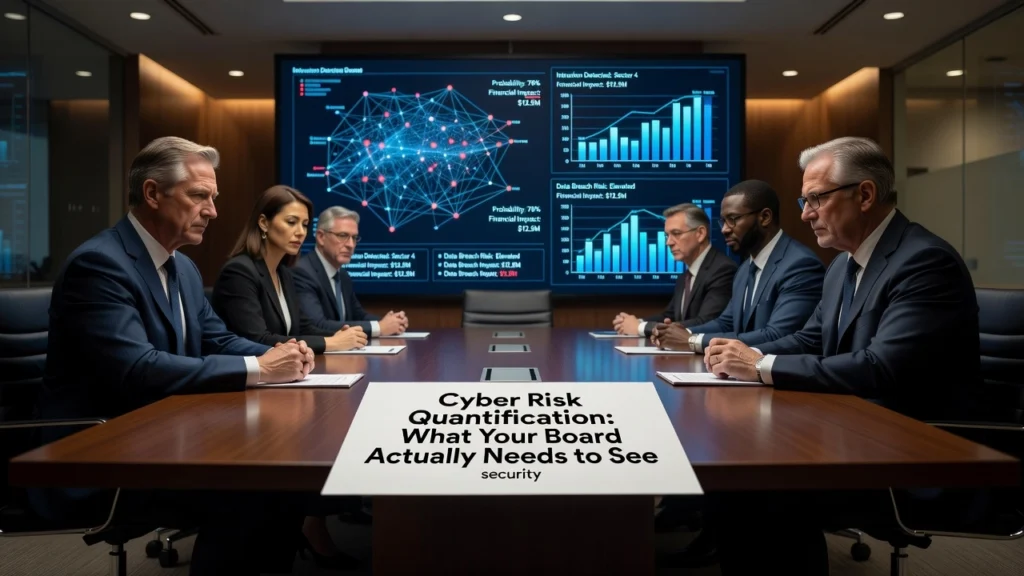
When a data breach makes headlines, the first question your board asks is rarely “what happened?” It is almost always “what does this cost us?” Yet most security leaders still walk into boardrooms armed with threat matrices, vulnerability counts, and color-coded risk charts that leave executives no closer to answering that fundamental financial question.
Cyber risk quantification changes that dynamic entirely. By translating technical risk into monetary terms, it gives leadership the financial clarity they need to make informed decisions about security investments, insurance coverage, and risk tolerance. It bridges the persistent gap between the CISO and the CFO, turning abstract threats into figures that belong in a business case or annual report.
This analysis breaks down exactly what effective cyber risk quantification looks like in practice, why traditional qualitative frameworks fall short in the boardroom, and how to structure your findings so executives can act on them with confidence. Whether you are building your first quantification model or refining an existing approach, you will leave with a clearer picture of what your board actually needs to see, and how to deliver it.
The Board Governance Gap That Makes CRQ Urgent
Cyber risk governance has a structural problem hiding in plain sight. According to MyLogiq data, only 15 firms in the entire S&P 500 maintain a dedicated cyber committee, which means that for the vast majority of public companies, cybersecurity oversight defaults to the audit committee. Research from the Center for Audit Quality confirms that 64% of S&P 500 companies explicitly assign cybersecurity responsibility to their audit committee, the same body already managing financial reporting integrity, external auditor relationships, internal controls, and regulatory compliance. Cybersecurity has simultaneously become the number-one audit committee priority and the mandate least suited to the committee’s existing skill set.
The core issue is not indifference; it is a fundamental mismatch in language. Audit committees are composed primarily of financial and legal professionals trained to evaluate capital allocation, probability-weighted loss scenarios, and measurable exposure ranges. When security teams present red-yellow-green heat maps and maturity scores, boards receive information they cannot translate into decisions. The governance gap is a data format failure, not a leadership failure. Boards already understand annualized loss expectancy, confidence intervals, and financial ranges; they simply are not receiving cyber risk data in those terms.
Regulatory pressure is accelerating this problem significantly. The SEC’s cybersecurity disclosure rules now require public companies to report material incidents within four business days of a materiality determination and to describe board oversight processes in annual filings. These requirements, detailed in recent guidance on 2025 reporting obligations, make qualitative assessments legally insufficient. EU AI Act compliance obligations are layering additional quantification demands on top of existing frameworks.
Mid-market organizations face this challenge with considerably fewer resources than large enterprises, lacking in-house quantification analysts, dedicated legal infrastructure for materiality determinations, and purpose-built governance structures. That resource asymmetry makes a scalable, advisory-led approach to cyber risk quantification not merely convenient, but strategically necessary.
What Cyber Risk Quantification Actually Means
Cyber risk quantification is, at its core, a translation exercise. It converts the abstract language of threat assessments, vulnerability scores, and qualitative risk ratings into something boards and finance committees can actually work with: dollar figures, probability ranges, and annualized loss expectations. Rather than telling a CISO that ransomware represents a “high” risk on a five-point scale, CRQ produces a statement like “there is a 30% probability of a ransomware event causing between $4M and $18M in losses over the next 12 months.” That shift in language is not cosmetic. It is the difference between a risk conversation and a business decision.
The dominant methodology underpinning most CRQ programs is FAIR, which stands for Factor Analysis of Information Risk. FAIR decomposes risk into two primary components: loss event frequency and loss magnitude. Loss event frequency examines how often a threat event is likely to occur, factoring in threat capability relative to control strength. Loss magnitude estimates the financial impact when an event does occur, separating primary losses (direct costs such as incident response, regulatory fines, and data recovery) from secondary losses (reputational damage, litigation, and customer churn). FAIR treats these sub-factors as independently measurable inputs, which allows analysts to calibrate each variable against historical loss data and threat intelligence rather than relying on subjective judgment.
The computational engine that brings FAIR inputs to life is Monte Carlo simulation. Instead of producing a single-point estimate, Monte Carlo runs thousands of probabilistic scenarios across the full range of input values. The output is a probability distribution of financial outcomes. A typical result might show a 10th-percentile loss of $600K and a 90th-percentile loss of $14M for a given ransomware scenario, giving decision-makers a realistic range rather than a misleadingly precise number.
This design directly serves board-level governance. CRQ outputs are built to answer the questions that audit committees and executive leadership actually ask: What is our maximum probable loss from a credential-compromise event? How much residual risk remains after we deploy endpoint detection and response? Does our current cyber insurance coverage align with our realistic exposure? These are not questions that a red-amber-green heat map can answer. Qualitative scoring systems produce ordinal rankings that cannot be aggregated across business units, compared over time, or used to justify a specific budget allocation. CRQ produces defensible, auditable financial figures that can withstand scrutiny from boards, auditors, insurers, and regulators alike.
Why Heat Maps and 1-to-5 Scores Break Down at the Board Level
Qualitative cyber risk scores carry a structural flaw that becomes impossible to ignore at the board level: they are ordinal, not cardinal. When a risk committee rates two threats as “High,” those ratings cannot be added, compared, or aggregated into a meaningful portfolio number. Two “High” scores do not produce a combined risk of known magnitude; they produce two labels. For a CFO reviewing a risk register, this is analogous to being told that a company has two large liabilities without being told whether each is $50,000 or $50 million. The FAIR risk framework was developed precisely because security leaders recognized that heat maps “generate board presentations without enabling actual decisions,” leaving executives unable to answer the most basic governance question: how much risk exposure does the organization actually carry?
The investment prioritization problem follows directly from this. A cell in the top-right corner of a heat map, representing high likelihood and high impact, is silent on financial magnitude. Security teams end up defending budget requests without a denominator. There is no principled way to decide whether a proposed $500,000 control investment is justified if the exposure it addresses has never been expressed in financial terms. Cyber risk quantification closes this gap by translating threat scenarios into probabilistic loss ranges, giving investment decisions the same numerical basis that actuaries use to price insurance and credit analysts use to model default risk. Boards and CFOs are trained to operate within exactly that framework; qualitative outputs ask them to abandon it.
The consequences extend beyond internal governance. Cyber insurance underwriters are tightening their submission requirements, increasingly expecting loss exposure models and financial risk data before binding coverage or setting premiums. Presenting a heat map to an underwriter is presenting information that cannot be mapped to a loss distribution curve, which is the basis on which premiums are actually calculated. Organizations that can supply probabilistic financial estimates are better positioned to negotiate terms and justify coverage limits.
Regulatory pressure is tightening on the same front. SEC cybersecurity disclosure rules require organizations to assess the materiality of cyber incidents, a determination that is inherently financial. When an examiner asks how a risk was rated, “our risk committee judged this a medium” is a materially weaker response than a documented probabilistic model with cited actuarial inputs and a defined confidence interval. The evidentiary gap between those two answers is where qualitative-only programs are most exposed.
Six High-Impact Use Cases for Cyber Risk Quantification
Understanding where cyber risk quantification delivers the most immediate business value helps organizations prioritize their CRQ investment and build internal momentum. The six use cases below represent the areas where CRQ consistently demonstrates measurable, defensible outcomes.
Board Reporting and Budget Justification
Security leaders have long struggled to translate technical priorities into executive decisions. CRQ closes that gap by converting control investment decisions into expected loss reduction values. Rather than presenting a wish list of security tooling, a CISO can demonstrate that deploying a specific control reduces annualized loss exposure by a defined dollar amount. The 2025 State of Cyber Risk Management Report from the FAIR Institute identifies improved business alignment and optimized cybersecurity spending as the top outcomes of mature CRQ programs, reinforcing that financial translation is not optional for organizations seeking board-level confidence in their security posture.
Cyber Insurance Optimization
The global cyber insurance market is projected to grow from USD 15.63 billion in 2024 to USD 32.19 billion by 2030, and insurers are tightening underwriting standards alongside that growth. Organizations that arrive at policy negotiations with CRQ-derived financial exposure data are better positioned to justify higher coverage limits, negotiate favorable premiums, and identify gaps between their actual exposure and existing policy terms. Qualitative maturity scores are increasingly insufficient for sophisticated underwriters who want defensible risk data, not attestations.
Third-Party Risk Management
Vendor risk has become one of the most urgent CRQ drivers. According to Cyber Risk Management Statistics 2025-2026, 40% of breach insurance claims involve a third party, and 24% of organizations suffered a third-party-caused security incident in 2024, up sharply from just 9% in 2020. Despite this trajectory, only 4% of organizations have high confidence that their vendor questionnaires accurately reflect actual risk. CRQ-based third-party modeling replaces low-confidence self-reporting with financially grounded exposure estimates tied to specific vendor relationships and breach scenarios.
M&A Due Diligence
Cyber risk routinely surfaces post-acquisition as an unpriced liability. CRQ enables acquiring organizations to assign a dollar-value range to inherited exposure during target evaluation, supporting purchase price adjustments, remediation escrows, or rep-and-warranty insurance structuring before close. This use case remains underserved in most due diligence frameworks, yet it directly addresses the post-close surprises that erode deal value.
Regulatory Compliance and Materiality Analysis
SEC cybersecurity disclosure rules require organizations to determine whether an incident is material, a judgment that is difficult to defend with a qualitative red-amber-green rating. The FAIR Institute has developed a dedicated FAIR Materiality Assessment Model to support financially grounded materiality determinations, and parallel frameworks are emerging under DORA and NIS2 in European jurisdictions. CRQ gives legal, compliance, and security teams a shared financial threshold rather than a contested interpretive judgment.
AI and Shadow AI Risk
According to 9 Cyber Risk Management Trends in 2025, 57% of employees use AI tools without formal organizational approval, creating exposure that conventional risk frameworks are not designed to capture. Dedicated AI Risk Quantification capabilities are emerging as a CRQ sub-discipline to model the financial impact of shadow AI adoption, third-party AI integrations, and AI-driven attack vectors. CRQ programs that do not explicitly account for AI-introduced risk are already operating with a significant blind spot.
Translating CRQ Outputs for Your CFO and Board
Effective CRQ board communication comes down to anchoring your presentation on three figures that carry real financial weight. The first is annualized loss expectancy (ALE) for your top risk scenarios, which establishes the baseline expected cost of inaction. The second is maximum probable loss at a defined confidence interval, typically the 95th percentile, which communicates tail risk in terms boards can compare against capital reserves and insurance coverage limits. The third is the expected risk reduction value from proposed control investments, which closes the loop between risk exposure and budget request. Together, these three numbers create a self-contained financial argument that requires no cybersecurity expertise to evaluate.
CFOs are well-positioned to engage with this framing because it mirrors the analytical language they already use. Expected value, confidence intervals, and return on mitigation investment are not novel concepts for finance leaders; they appear routinely in treasury risk models, insurance actuarial analysis, and capital allocation decisions. When a CISO presents cyber risk in these terms, the conversation shifts from a request for trust to a request for a business decision, and that shift matters significantly in how budget proposals are received.
A concrete example illustrates the practical power of this approach. Consider a mid-market organization evaluating a $400,000 endpoint detection and response investment. Without it, modeled annualized loss from ransomware sits at $2.1 million at the 50th percentile and $6.8 million at the 90th percentile. With the investment in place, those figures drop to $900,000 and $3.2 million respectively. Presented this way, the CFO is not being asked to believe in cybersecurity; they are being asked to evaluate whether a $400,000 expenditure is justified by a modeled reduction in expected loss. That is a capital allocation question, and finance leaders answer those every quarter.
Mid-market CISOs should resist the temptation to present an exhaustive risk register. Two or three prioritized scenarios, selected for their combination of high expected loss and clear remediation path, are far more persuasive than a comprehensive list that disperses attention and signals a lack of analytical discipline. Ransomware and third-party supply chain compromise are consistently strong candidates for this shortlist, given current threat data and the direct availability of control-based remediation options.
Boards and audit committees do not need to understand what cyber risk quantification involves at a methodological level. Whether the underlying model uses FAIR or Monte Carlo simulation is operationally irrelevant to a board’s governance function. What matters to directors and audit committee members is that the numbers are defensible if scrutinized, consistently produced using the same methodology each cycle, and comparable period over period so that progress or deterioration is visible over time. Building that confidence is a communication discipline, not a technical one, and it is where mid-market security leaders have the most room to improve their board relationships.
CRQ vs. Qualitative Risk Scoring: A Direct Comparison
The contrast between qualitative risk scoring and cyber risk quantification comes into sharp focus when you examine five dimensions that matter most to security, finance, and executive stakeholders.
Output format is the most immediate difference. Qualitative scoring produces categorical labels: Low, Medium, High, Critical. These categories are fast to generate and easy to visualize on a heat map, but they carry no numerical weight. A board member cannot compare “High ransomware risk” against a $2M insurance deductible or a $15M quarterly revenue target. CRQ replaces those labels with probability distributions and financial ranges, for example, a $4.2M to $11.7M probable loss exposure at 30% annual likelihood. That output can sit directly alongside a budget line item, an insurance limit, or a revenue-at-risk figure, enabling real comparisons rather than judgment calls.
Investment justification exposes a deeper structural gap in qualitative methods. When a security team recommends a $500K endpoint detection investment, a qualitative rating cannot tell the CFO what that investment actually changes. CRQ produces a measurable delta: the difference in expected annual loss before and after a proposed control is implemented. A control that reduces expected loss from $3.1M to $900K per year generates a documentable return that finance leadership can evaluate using the same criteria applied to any capital expenditure.
Board and executive communication depends heavily on credibility and reproducibility. Color-coded heat maps require executives to accept the security team’s subjective judgment without an auditable basis. Two analysts reviewing identical data can reach different categorical conclusions. CRQ outputs are grounded in documented assumptions, making them stress-testable and reproducible across review cycles. As Gartner’s 2026 Innovation Insight report formally recognized, CRQ has transitioned from an emerging practice to an increasingly essential component of modern cyber risk management, precisely because its outputs meet the governance standards boards now expect.
Insurance and regulatory applicability is where qualitative scoring faces its most consequential limitation. Insurers underwriting cyber policies and regulators evaluating materiality disclosures both require defensible, quantified data. A “High” rating does not satisfy an underwriter assessing probable maximum loss, nor does it meet SEC-style materiality thresholds. CRQ outputs address both requirements directly, providing the financial figures that underwriting models consume and that materiality analyses require.
Implementation complexity is the honest tradeoff. Qualitative scoring is faster and cheaper to stand up; it requires expert interviews and heat-map templates rather than data pipelines or actuarial modeling. CRQ demands investment in methodology, tooling or advisory support, and ongoing data collection. However, for mid-market organizations simultaneously managing board pressure, insurance renewals, and regulatory disclosure obligations, that upfront investment pays returns that qualitative scoring structurally cannot match.
Four CRQ Trends Reshaping How Mid-Market Teams Measure Risk
The CRQ discipline is not static. Four structural shifts are actively changing how mid-market security and risk teams build, operate, and report their quantification programs in 2025 and beyond.
AI Risk Quantification (AIRQ) is emerging as a dedicated sub-discipline within CRQ. The trigger is straightforward: 57% of employees use AI tools without formal organizational approval, creating unquantified financial exposure that traditional risk frameworks were never designed to capture. Platforms are responding by building specific AIRQ modules that measure the financial risk introduced by both internal AI adoption and third-party AI integrations. The practical value for mid-market teams is that AIRQ shifts the conversation away from generic control checklists toward prioritized remediation ranked by potential financial impact. Shadow AI is not a future risk; it is an active, unmanaged exposure sitting inside most organizations today, and CRQ frameworks that fail to account for it are working with incomplete inputs.
Continuous Control Monitoring (CCM) is displacing the traditional point-in-time risk snapshot. Annual or quarterly risk assessments produce financial estimates that are outdated before they reach the board. CRQ platforms are now embedding real-time control effectiveness data so that financial risk figures update continuously as the threat environment and control posture change. For mid-market teams managing lean security functions, this shift means the board no longer receives a number anchored to conditions that existed six months ago. The risk picture stays current without requiring a full reassessment cycle every time something changes.
Regulatory pressure is converting informal risk programs into structured, auditable ones. The EU AI Act sets a binding enforcement deadline of August 2, 2026 for high-risk AI system obligations, with penalties reaching up to 15 million euros or 3% of global annual turnover. Separately, SEC materiality disclosure obligations are pushing organizations to produce board-reportable, financially quantified cyber risk data rather than qualitative summaries. Both regulatory drivers favor organizations that have already formalized their CRQ programs with documented methodologies and reproducible outputs.
Cloud-based CRQ deployment is removing the infrastructure barrier for mid-market adoption. On-premise risk platforms require internal resources that most mid-market organizations simply do not maintain. Cloud-hosted CRQ tools and managed advisory services compress the time-to-value significantly and allow smaller security teams to access quantification capabilities that were previously practical only for large enterprises. According to IBM’s 2024 Cost of a Data Breach Report, organizations using AI and automation for security identified and contained breaches approximately 100 days faster than those that did not, reinforcing that AI-integrated risk programs deliver measurable operational benefits alongside the financial visibility that CRQ provides.
Third-Party Risk Is Now a Primary CRQ Driver
The numbers tell a story that security teams can no longer afford to interpret charitably. Third-party-caused security incidents affected just 9% of organizations in 2020. By 2024, that figure had reached 24%, a near-threefold increase in four years driven by the accelerating depth of supply chain integration, SaaS adoption, and managed service dependency across nearly every industry. This is not a gradual drift; it is a structural transformation in where organizational risk actually lives.
The insurance market has already priced this reality. According to the Resilience 2024 Cyber Risk Report, 40% of cyber insurance breach claims involve a third party. That single statistic carries a direct implication for any organization that has not modeled vendor-introduced risk in financial terms: you are almost certainly underestimating your largest single category of insurance exposure. The financial loss from a compromised payroll processor, a breached cloud storage vendor, or a ransomware event propagating through a managed IT provider does not stay contained to that vendor. It lands on your balance sheet.
The conventional response to this problem, the annual security questionnaire, has been measured and found structurally inadequate. Only 4% of organizations report high confidence that their third-party questionnaires accurately reflect actual vendor risk. Despite this, companies continue sending questionnaires at scale, consuming compliance resources while generating false assurance. The gap between questionnaire volume and actual risk confidence is not a process failure; it is a methodological one. Questionnaires measure what vendors say about their controls. They do not model what your organization loses if those controls fail.
CRQ-based third-party risk modeling reframes the question entirely. Instead of asking whether a vendor has completed a SOC 2 audit, it asks: what is the probability this SaaS provider is compromised in the next 12 months, what data and operational dependencies do we carry on that relationship, and what is the expected financial loss from that scenario given our contractual exposure and recovery costs? Those inputs, probability of vendor compromise, data exposure volume, operational dependency, and liability, produce an output that finance and the board can act on.
For mid-market organizations that have built their operating model on managed service providers, cloud platforms, and third-party software rather than internal capability, this framing is not a sophisticated add-on to a mature CRQ program. It is the correct starting point. Third-party concentration risk is often the single most material financial exposure these organizations carry, and it is the scenario where a basic quantitative model delivers immediate, defensible value before any other CRQ use case is developed.
How Mid-Market Organizations Can Start With CRQ
The most common mistake mid-market organizations make when approaching CRQ is attempting to quantify everything at once. A full risk register quantification effort requires data maturity, analyst bandwidth, and institutional familiarity with probabilistic modeling that most teams simply have not yet developed. The more effective approach is narrower: select one high-stakes, board-visible scenario and model it end-to-end before attempting anything broader. Ransomware is the natural starting point for most organizations, given its frequency and the clarity of its financial impact across downtime, recovery costs, ransom payments, and regulatory notification expenses. A major SaaS vendor breach or a regulatory incident tied to a data classification failure are equally strong candidates. The goal of this first scenario is not comprehensiveness; it is familiarity. Working through a single FAIR-based model teaches your team how inputs map to outputs, where estimation uncertainty lives, and how to present a probabilistic loss range to leadership in terms they can act on.
The data required to run that first model is almost certainly already sitting in your organization. Incident history from your SIEM or ticketing system informs threat frequency estimates. Your cyber insurance policy limits and renewal premiums provide an external market signal for how insurers are pricing your exposure. Asset inventories identify the systems in scope for your chosen scenario. Vendor lists feed directly into third-party contact frequency assumptions. Past audit findings and penetration test reports document control gaps that affect vulnerability estimates in FAIR’s loss event frequency calculation. None of these inputs require a dedicated data science function to gather; they require coordination across IT, legal, and finance, which is exactly the kind of cross-functional alignment that a first CRQ exercise helps build.
The Platform vs. Advisory Tradeoff
For resource-constrained teams, the build-versus-buy question has a practical answer. Enterprise CRQ platforms offer sophisticated Monte Carlo simulation, continuous control monitoring integrations, and automated reporting workflows, but they also carry significant onboarding requirements, ongoing data maintenance obligations, and the implicit need for at least one analyst trained in quantitative risk modeling to operate them effectively. That overhead is manageable for large security organizations with dedicated risk functions; for mid-market teams already managing their core security program with lean headcount, it represents a meaningful capacity drain before the first output is ever produced.
The managed advisory model sidesteps that constraint by delivering defensible CRQ outputs through a structured engagement rather than a platform license. An advisory partner brings the methodology, the modeling framework, and the analyst expertise; your team provides the organizational data and domain knowledge. The result is a board-ready financial exposure analysis tied to your actual risk profile, without the runway required to build an internal quantification capability from scratch.
HecateLabs works with mid-market organizations at exactly this entry point. Engagements are scoped to your current risk profile, your board reporting cadence, and your insurance renewal timeline, so the first CRQ output serves an immediate business purpose rather than sitting as an internal exercise. The objective is a program that grows with your organization’s maturity, not one that requires an enterprise software budget or a dedicated risk quantification hire to sustain.
Using CRQ to Optimize Cyber Insurance Coverage
Cyber insurers are raising the bar on what they expect from applicants before binding coverage, particularly for organizations seeking limits above $5 million or operating in regulated, high-risk verticals such as healthcare and financial services. Where a completed questionnaire once sufficed, underwriters increasingly expect applicants to demonstrate a quantified understanding of their actual financial exposure. This shift creates a meaningful disadvantage for organizations that still rely on broker benchmarks or prior-year carry-forwards to set their coverage levels, neither of which answers the fundamental question insurance is designed to address: what financial loss are you actually trying to transfer?
CRQ outputs give mid-market organizations three concrete advantages in insurance negotiations. First, modeled loss scenarios provide a defensible basis for justifying higher coverage limits, replacing gut-feel estimates with annualized expected loss figures and loss exceedance curves that underwriters can evaluate on their own terms. Second, at renewal, organizations with CRQ data can challenge premium increases by presenting documented evidence of control improvements and corresponding reductions in expected loss magnitude. Third, CRQ analysis surfaces coverage gaps that would otherwise remain invisible. A real-world case involving a financial institution found a $4.68 million coverage gap on a single ransomware scenario, a gap that only became visible through FAIR-based quantification analysis.
One of the more revealing findings in CRQ-assisted insurance reviews is a persistent misalignment in how coverage is structured. Organizations frequently carry excess coverage for low-probability, low-severity events while remaining significantly underinsured for the mid-range loss scenarios that CRQ modeling identifies as the highest expected-value exposures. This asymmetry is not intentional; it is the predictable result of purchasing insurance without a quantified view of which scenarios are most likely to generate material losses.
The link between security control investment and insurance outcome also becomes measurable with CRQ. An organization that models how deploying MFA across privileged accounts reduces expected ransomware loss magnitude can bring that analysis directly to an underwriter as the basis for a premium reduction request. This is a fundamentally different posture than attestation. Instead of checking a box confirming that MFA exists, the organization is presenting documented evidence of how that control changes the financial risk profile.
In a hardening market where underwriters hold more discretion over pricing and coverage terms, presenting CRQ outputs positions mid-market organizations as analytically sophisticated, lower-risk policyholders. That differentiation carries real weight when renewals are competitive and insurers are actively repricing accounts based on the quality of risk evidence they receive.
Turning Risk Into a Language Your Entire Organization Speaks
Cyber risk quantification is not a platform you deploy or a compliance checkbox you tick once a year. It is a fundamental shift in how your organization talks about risk, replacing categorical labels like “High” and “Medium” with financial figures that executives, board members, and insurers already use to make decisions. That communication shift is where the real value lives.
Mid-market organizations have the most to gain from making this shift. The board pressure, insurance scrutiny, and regulatory expectations they face are structurally identical to those confronting large enterprises, but the internal resources available to respond are far more constrained. A mid-market CISO often cannot afford a dedicated risk analyst team or an enterprise-grade platform license, yet still faces the same materiality disclosure requirements and insurer demands for defensible loss data.
The practical entry point is a single, well-scoped scenario modeled to financial exposure and presented in the language of expected loss and return on mitigation investment. Start with your highest-probability, highest-impact scenario, put a dollar figure on it, and show what a specific control investment reduces that figure to.
For most mid-market organizations in 2026, three scenarios warrant immediate attention: third-party vendor exposure (where 40% of breach insurance claims already originate), shadow AI risk (with 57% of employees using unapproved AI tools), and cyber insurance optimization. Organizations looking to build a board-ready CRQ program without enterprise platform overhead can explore how HecateLabs structures managed CRQ advisory specifically for mid-market security teams.