
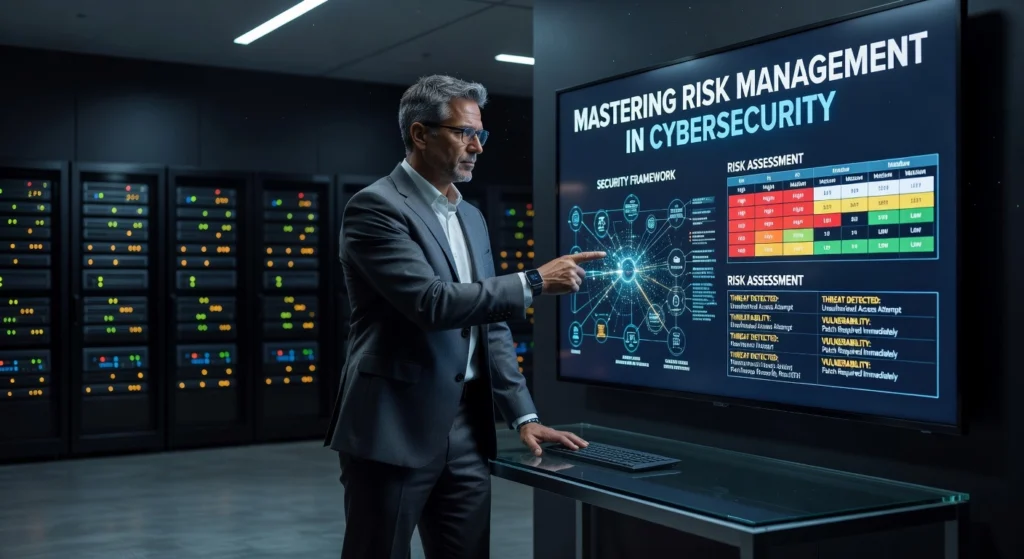
Imagine a single overlooked vulnerability that cascades into a multimillion-dollar breach, crippling operations and eroding customer trust overnight. Such incidents are not rare anomalies; they underscore a harsh reality in today’s digital landscape. For cybersecurity professionals at the intermediate level, the path to prevention lies in mastering risk management in cyber security.
This post delves into the analytical frameworks and strategies that elevate risk management from a checklist exercise to a proactive discipline. You will explore proven methodologies, including quantitative risk assessments, threat modeling, and the integration of frameworks like NIST and ISO 27001. We analyze real-world case studies, such as the Colonial Pipeline ransomware attack, to dissect what went wrong and how robust risk prioritization could have mitigated the damage.
By the end, you will gain actionable insights to refine your organization’s risk posture, align security investments with business objectives, and navigate emerging threats like AI-driven attacks. Whether you are a security analyst or IT manager, these tools will empower you to lead with confidence in an era of relentless cyber evolution.
The Growing Imperative of Cybersecurity Risk Management
Cyber incidents have solidified their position as the number one global business risk for the fifth consecutive year, according to the Allianz Risk Barometer 2026, with 42% of respondents across 97 countries identifying them as the top threat. This ranking, the highest ever recorded, spans all regions, sectors, and company sizes, but mid-sized firms with revenues between $100 million and $500 million face acute vulnerabilities due to resource constraints and heavy reliance on third-party vendors. These organizations, often comprising 24% of survey respondents, struggle with ransomware extortion and operational disruptions that larger enterprises mitigate more effectively through scaled investments. The barometer notes a decade-long climb from cyber’s eighth-place ranking, driven by AI-enhanced attacks and supply chain weaknesses. For mid-market leaders, this underscores the need for immediate risk prioritization to avoid cascading business interruptions.
The financial implications amplify the urgency of robust risk management in cybersecurity. Projections indicate global cybercrime costs will hit $10.5 trillion annually by 2026, per Ordr.net statistics, while the average data breach now costs $4.88 million, factoring in detection, response, and lost revenue. Mid-sized firms, with leaner budgets, absorb these hits disproportionately; a single ransomware incident can derail quarterly goals. Actionable insight: conduct regular threat modeling to quantify potential impacts using frameworks like FAIR, enabling prioritized mitigation over reactive spending.
Middle-market executives report stark realities: 18% experienced data breaches in the past year, and 24% faced ransomware demands, as detailed in the RSM Middle Market Cybersecurity Report. These incidents often stem from unpatched edge devices or weak multi-factor authentication, exacerbated by “shadow AI” deployments. Despite 81% planning spending increases, only 35% prioritize strategy alignment, highlighting a gap in proactive governance.
The WEF Global Cybersecurity Outlook 2026 reveals that 90% of small and medium firms lack sufficient resilience, making them twice as likely to falter compared to larger peers. Skill shortages and ecosystem blind spots compound this, with AI vulnerabilities cited by 87% as the fastest-growing risk.
Ultimately, effective risk management in cybersecurity aligns security with business objectives, transforming threats into opportunities for resilient growth. By integrating NIST CSF steps—identify, protect, detect, respond, recover—mid-market organizations can secure innovation amid AI, geopolitical, and supply chain challenges, ensuring operational continuity.
Core Components of the Cybersecurity Risk Management Process
Identification Phase: Building a Solid Foundation
The identification phase forms the bedrock of effective risk management in cybersecurity by cataloging all organizational assets and mapping associated threats and vulnerabilities. Mid-market organizations should start with comprehensive asset inventories, using automated discovery tools to list hardware, software, data repositories, and personnel across on-premises, cloud, and hybrid environments. For instance, classify assets by criticality, such as customer databases as high-value targets prone to ransomware, which affected 24% of middle-market firms last year per RSM US data. Threat modeling techniques, like OWASP’s STRIDE methodology (Spoofing, Tampering, Repudiation, Information Disclosure, Denial of Service, Elevation of Privilege), help decompose applications via data flow diagrams to pinpoint entry points and trust boundaries. Integrate threat intelligence feeds and vulnerability databases, such as CISA’s Known Exploited Vulnerabilities catalog, to map risks like AI-powered phishing, now the fastest-growing threat according to 87% of organizations in the World Economic Forum’s Global Cybersecurity Outlook 2026. Actionable step: Conduct quarterly inventory audits to maintain accuracy, reducing blind spots that contribute to the 277-day average dwell time for breaches.
Assessment and Prioritization: Quantifying and Ranking Risks
Once identified, risks undergo rigorous assessment to evaluate likelihood and impact, with prioritization tailored for mid-market scalability. The FAIR (Factor Analysis of Information Risk) model stands out for quantitative analysis, breaking risk into loss event frequency and magnitude via Monte Carlo simulations, translating cyber threats into dollar terms, such as potential $4.88 million breach costs. For resource-constrained teams, multi-dimensional scoring combines asset criticality, exploitability from CVE data (over 30,000 new in 2026), and business impact analysis, aligning with NIST SP 800-30. See detailed FAIR application in Hyperproof’s cybersecurity risk management process guide. Mid-market leaders report 35% prioritization on strategy, up recently per RSM, amid supply chain risks cited by 65% of firms. Prioritize high-likelihood vectors like third-party vulnerabilities, enabling focused remediation.
Treatment Options: Strategic Responses to Prioritized Risks
Treatment involves selecting from mitigate, transfer, avoid, or accept based on risk appetite and cost-benefit analysis. Mitigation deploys controls such as zero-trust architecture, enforcing least-privilege access and micro-segmentation to assume breach, as recommended by CISA’s maturity model; this counters identity exploits in 70% of cloud incidents. Transfer risks via cybersecurity insurance, adopted by 75% of larger peers, or contractual clauses with vendors. Avoid by decommissioning legacy systems vulnerable to quantum threats, while accept low-residual risks with documented monitoring. Cycognito outlines these options effectively, emphasizing automation in SDLC.
Ongoing Monitoring and Review: Ensuring Continuous Resilience
Risk management demands perpetual vigilance through AI-driven tools for real-time threat detection, slashing triage time by 90% in SIEM platforms. Conduct incident simulations like tabletops quarterly and regular audits to validate controls, incorporating lessons from the 18% breach rate in mid-market per RSM. Track metrics such as mean time to detect (MTTD) and patch compliance amid AI offense trends.
For structured implementation, the HeightsCG Risk Management Workflow Guide offers tailored workflows aligning NIST CSF 2.0 and ISO 27001, with risk registers and quarterly cycles ideal for cybersecurity leaders facing $10.5 trillion annual cybercrime costs. This cyclical approach builds resilience for mid-market firms.
Step 1: Identifying Assets, Threats, and Vulnerabilities
The first step in risk management in cyber security establishes a clear inventory of assets, threats, and vulnerabilities, directly aligning with the NIST Cybersecurity Framework (CSF) 2.0 Identify function. This foundational phase, encompassing asset management (ID.AM), risk assessment (ID.RA), and improvement (ID.IM), enables mid-market organizations to prioritize risks tied to business objectives. With cyber incidents ranked as the top global business risk by 42% of executives per the Allianz Risk Barometer 2026, and 18% of middle-market firms reporting breaches last year, comprehensive identification prevents costly disruptions averaging $4.88 million per incident.
Begin with comprehensive asset inventories covering hardware like servers and endpoints, software applications, sensitive data with metadata, and third-party dependencies such as cloud providers. Use automated discovery tools combined with physical audits and vendor records to map dependencies and data flows, categorizing assets by criticality (high, medium, low) based on mission impact. For mid-market efficiency, integrate these into a centralized database updated quarterly through change management, addressing challenges like legacy systems where 67% of supply chain risks arise from untracked third-parties.
Next, perform threat modeling to anticipate adversary tactics, including AI-enhanced phishing, which surged 1,265% in 2025, and supply chain exploits targeting SaaS and open-source components. Conduct quarterly workshops using threat intelligence to assess likelihood and impact, focusing on tactics like deepfake lures or identity abuse via OAuth. This proactive approach, per NIST ID.RA-02/03, helps mid-market teams simulate attacks on revenue-critical paths.
Scan for vulnerabilities with automated tools prioritizing critical systems like cloud services, emphasizing exploitability over raw CVSS scores. Leverage known exploited vulnerabilities (KEV) catalogs amid 48,185 CVEs published in 2025, integrating scans with continuous monitoring for misconfigurations in AWS or Azure environments common to mid-sized operations.
Finally, integrate business context by prioritizing high-value assets in revenue-generating operations, such as CRM data flows, using risk registers to link vulnerabilities to financial impacts. Guided by NIST CSF, this ensures lean, scalable defenses amid 61% of mid-market firms lacking dedicated staff, fostering resilience against AI and geopolitical threats.
Leading Frameworks Guiding Risk Management
NIST Cybersecurity Framework: A Risk-Based Foundation
The NIST Cybersecurity Framework (CSF) 2.0 stands as a cornerstone for risk management in cyber security, offering a flexible, voluntary structure applicable to organizations of all sizes, including mid-market firms facing resource constraints. Released in February 2024, it organizes cybersecurity outcomes into six core functions: Govern, Identify, Protect, Detect, Respond, and Recover, enabling a continuous, risk-prioritized approach aligned with business objectives. The Govern function establishes overarching risk strategies, policies, supply chain oversight, and roles to define risk appetite. Identify involves asset inventories, threat modeling, and vulnerability assessments to pinpoint risks. Protect deploys safeguards like access controls, training, and data encryption; Detect focuses on continuous monitoring for anomalies; Respond handles incident mitigation and reporting; and Recover ensures restoration and lessons learned. Mid-market leaders can use NIST Profiles for gap analysis between current and target states, with Tiers assessing maturity from partial to adaptive. For instance, 90% of small and medium enterprises lack sufficient resilience, per the World Economic Forum’s Global Cybersecurity Outlook 2026, making NIST’s scalability vital as cyber incidents top global risks at 42% concern rate.
ISO 27001 and ISO 27005: Compliance-Driven Risk Treatment
ISO 27001 establishes an Information Security Management System (ISMS) with mandatory risk assessments, while ISO 27005 provides detailed guidelines for identifying threats to confidentiality, integrity, and availability. Organizations define risk criteria using likelihood-impact scales (e.g., 1-5), assess via asset-threat-vulnerability matrices, and develop treatment plans selecting mitigate, avoid, transfer, or accept options. Controls from Annex A, such as backups and access management, form the Statement of Applicability, reviewed annually for continual improvement. This duo suits compliance-focused mid-market firms, where 81% plan cybersecurity spending increases and 35% prioritize strategy, enabling certification, audits, and vendor trust with simple tools like spreadsheets for 30-360 risks. A practical insight: Involve department heads early to align treatments with operations, reducing breach costs averaging $4.88 million globally.
Emerging 2026 Frameworks and the FAIR Model
Looking to 2026, frameworks emphasize AI governance (e.g., NIST AI RMF for trustworthy systems), supply chain risk (NIST GV.SC for supplier due diligence amid 65% citing it as top challenge), and quantum readiness (post-quantum cryptography migrations). These address AI vulnerabilities, the fastest-growing risk at 87%, and supply chain gaps where only 33% map ecosystems fully. The FAIR model advances prioritization quantitatively, calculating risk as Loss Event Frequency times Loss Magnitude via Monte Carlo simulations, contrasting qualitative heat maps’ subjective scales.
| Aspect | Qualitative | Quantitative (FAIR) |
|---|---|---|
| Method | High/medium/low | Data ranges, simulations |
| Output | Ratings | $ loss estimates |
| Strengths | Quick overview | ROI, business alignment |
| Weaknesses | Bias, no math | Initial data needs |
Adaptability for Mid-Market Environments
NIST CSF excels as a versatile starting point for resource-limited settings, where 61% of mid-sized businesses lack dedicated staff; layer with ISO for compliance and FAIR for quantification as maturity grows. Actionable step: Begin with NIST Quick Start Guides for rapid implementation, fostering resilience against $10.5 trillion annual cybercrime costs. This adaptability ensures mid-market firms, hit by 18% breach rates, prioritize effectively in AI and supply chain eras.
Key Risks and Trends Defining 2026
AI Vulnerabilities: Fastest-Growing Risk
Artificial intelligence vulnerabilities represent the fastest-growing risk in cybersecurity, with 87% of organizations identifying them as such according to the World Economic Forum’s Global Cybersecurity Outlook 2026. This surge stems from AI’s dual role in amplifying attacks, such as deepfake phishing and adversarial manipulations, while 77% of firms deploy AI defensively for phishing detection, anomaly response, and behavioral analytics. However, a critical 54% skills gap impedes effective implementation, leaving mid-market organizations particularly exposed due to limited in-house expertise. For instance, unmonitored generative AI tools can leak sensitive data, as seen in recent incidents where shadow AI bypassed controls. To address this in risk management, conduct regular AI tool assessments, invest in targeted training for threat analysts, and establish governance frameworks aligned with NIST CSF. Mid-market leaders should prioritize scalable AI defenses to close these gaps without expansive budgets.
Supply Chain and Third-Party Risks: Top Challenge
Supply chain and third-party risks dominate as the top challenge for 65% of organizations, exacerbated by incomplete visibility into extended ecosystems. Only 33% fully map their supplier networks, including fourth- and nth-party dependencies, which account for half of breaches. This vulnerability cascades to mid-market firms reliant on concentrated vendors, where a single weak link can trigger widespread disruption, as evidenced by recent high-profile incidents. Effective risk management demands continuous monitoring, supplier maturity evaluations, and simulation of third-party incident responses. Adopt AI-powered platforms for automated mapping and risk scoring to enhance resilience. Transitioning to zero-trust models across the chain further mitigates inheritance risks.
Post-Quantum Cryptography Urgency
Quantum computing threats necessitate immediate crypto-agile migrations to safeguard long-lived encryption assets. Current standards like RSA face breakage risks by 2030, urging organizations to inventory cryptographic assets and pilot post-quantum algorithms per NIST guidelines. Mid-market firms must build agility through centralized key management and API-driven swaps to avoid operational downtime. Delaying action heightens exposure for sectors like finance and manufacturing with legacy systems. Actionable steps include phased roadmaps: assess, plan, and monitor with hybrid crypto implementations.
Geopolitical Hybrid Threats
Geopolitical tensions fuel hybrid threats, with 64% of leaders factoring state-sponsored attacks into strategies, blending cyber espionage and physical sabotage. Confidence in national responses has declined sharply to 31%, amplifying the need for proactive defenses. Mid-market organizations face elevated risks from infrastructure-targeted campaigns. Integrate nation-state intelligence into risk assessments and conduct hybrid simulations for preparedness.
Resilience Shift in Mid-Market
An 81% of mid-market firms are ramping up cybersecurity spend, prioritizing strategy and risk management at 35%, per the RSM Middle Market Business Index. This follows 18% breach rates and 24% ransomware encounters, driving focus on detection, response, and identity controls. Despite budget constraints, RSM’s special report highlights a strategic pivot toward governance and simulations. Embed cyber resilience into business objectives for sustained protection. These trends underscore the imperative for adaptive risk management frameworks.
Mid-Market Challenges and Opportunities
Mid-market organizations, typically those with $50 million to $1 billion in annual revenue, confront distinct hurdles in risk management in cyber security that heighten their vulnerability to cyber incidents, ranked as the top global business risk. A staggering 61% lack dedicated cybersecurity staff, per BrightDefense cybersecurity statistics, which intensifies exposure to threats like cyber-enabled fraud affecting 73% of organizations or their networks, according to the World Economic Forum. This staffing deficit leaves critical gaps in threat detection and response, as small and medium-sized firms are twice as likely to lack resilience compared to larger enterprises. Without in-house experts, routine vulnerabilities in firewalls, VPNs, or multi-factor authentication go unaddressed, enabling phishing, ransomware demands (impacting 24% of mid-market firms), and escalating fraud via deepfakes or identity theft. Actionable insight: Adopt an “assume compromise” posture by prioritizing endpoint detection and response tools to contain breaches early and minimize downtime.
Budget constraints further compel mid-market leaders to favor lean, outsourced solutions over costly in-house teams. 81% plan cybersecurity spending increases, yet economic pressures make managed detection and response (MDR) services preferable, offering 24/7 monitoring without the overhead of a security operations center. MDR addresses alert fatigue and skills shortages, delivering expert-led threat hunting at a fraction of full-time hire costs, with the market projected to expand rapidly through 2031. This shift aligns with 39% focusing on detection and response, enabling proactive risk treatment via automation and zero-trust architectures.
Maturity is emerging, as 35% now prioritize risk management strategies, a significant rise signaling a proactive pivot from reactive fixes, per RSM reports. Leverage scalable services like penetration testing and red teaming to simulate attacks, uncover weaknesses, and validate defenses without permanent staff. These as-a-service models provide continuous vulnerability assessments integrated into cloud and compliance workflows.
Despite inequities, mid-market agility shines in quicker AI adoption for defenses like phishing detection (77% usage), outpacing larger firms bogged down by bureaucracy. Bridge gaps by outsourcing risk assessments and embracing AI governance to counter the fastest-growing threat: AI vulnerabilities cited by 87%. This positions mid-market firms for resilient growth in 2026’s threat landscape.
Effective Risk Treatment and Mitigation Strategies
Implement Zero-Trust and AI Automation for Mitigation
In risk management in cyber security, mitigation strategies like zero-trust architecture (ZTA) and AI automation stand out for their ability to shrink attack surfaces effectively. ZTA operates on the principle of “never trust, always verify,” incorporating continuous authentication, least-privilege access, and micro-segmentation to curb lateral movement by attackers. When paired with AI-driven tools, such as user and entity behavior analytics (UEBA) and anomaly detection, organizations achieve mean-time-to-detect (MTTD) under 15 minutes and mean-time-to-respond (MTTR) below 30 minutes, while reducing false positives by over 85%, according to recent analyses. For mid-market firms, this approach delivers a 285% ROI through unified platforms that lower total cost of ownership by 60%. Actionable steps include deploying AI for predictive threat modeling and automated responses, which block 95% of credential-based attacks. Seceon’s guide on zero-trust AI security highlights how these integrations adapt to hybrid cloud environments, where 82% of organizations operate.
Transfer Risks Through Cyber Insurance Integrated with Resilience Roadmaps
Transferring risks via cyber insurance provides financial stability against escalating breach costs, averaging $4.88 million globally and rising with ransomware demands affecting 24% of mid-market firms. Leading advisors recommend bundling policies with resilience roadmaps, reinvesting premium savings into controls like incident response testing and endpoint protection to meet insurer requirements. This strategy quantifies exposures using economic modeling, turning insurance into a catalyst for broader defenses amid a buyer-friendly market projected through 2026. Mid-market organizations benefit by aligning coverage with supply chain assessments, where 65% of risks originate from third parties. Key actions involve annual policy reviews tied to KPIs from drills and analytics, ensuring premiums reflect enhanced maturity.
Avoid Unnecessary Exposures by Decommissioning Legacy Systems
Proactively avoiding risks demands decommissioning legacy systems vulnerable to quantum threats, as 2026 marks a critical “harvest now, decrypt later” era with qubit requirements for breaking RSA-2048 plummeting below one million. Inventory cryptographic assets per NIST guidelines, then migrate to post-quantum algorithms like those standardized in 2024, phasing out outdated TLS and VPN protocols. This prevents non-compliance with looming deadlines, such as NSA’s 2027 targets, and safeguards long-lived data in health or IP sectors. For mid-market efficiency, prioritize high-value assets to control costs, avoiding resource spikes from delays.
Accept Residual Risks with Documented Rationale and Enhanced Monitoring
Accepting residual risks—those remaining after controls—requires rigorous documentation in risk registers, detailing likelihood, impact, and cost-benefit rationale per NIST CSF and ISO 27001. Enhance oversight with network detection and response (NDR), continuous threat hunting, and audits to validate tolerance levels. This approach, integral to the Govern function in NIST CSF 2.0, ensures residuals align with business appetite while enabling insurance for uncovered gaps.
Tailoring Strategies for Mid-Market Organizations
Mid-market firms, where 61% lack dedicated cybersecurity staff and 90% face resilience shortfalls, must prioritize high-impact controls like universal multi-factor authentication (MFA) enforcement, countering 95% of identity attacks amid AI phishing surges. Trends emphasize lean tools such as managed detection and response, with 81% planning spending increases focused on strategy. Hecatelabs.io empowers these organizations with scalable zero-trust implementations and AI automation tailored to budget constraints, fostering resilience against cybercrime costs projected at $10.5 trillion annually. Forbes Tech Council outlines 2026 strategies reinforcing MFA and vendor governance as essentials.
Continuous Monitoring and Adaptation
Deploy AI Tools for 24/7 Threat Hunting and Anomaly Detection
In risk management in cyber security, deploying AI tools for continuous threat hunting and anomaly detection is essential for mid-market organizations, where 39% prioritize detection and response amid resource constraints. These tools analyze vast datasets in real-time, identifying subtle behavioral anomalies that signature-based systems miss, such as AI-enhanced phishing or zero-day exploits. For instance, platforms leveraging machine learning can reduce mean time to detect (MTTD) from days to hours, addressing the 18% breach rate reported by mid-market firms last year. According to the World Economic Forum’s Global Cybersecurity Outlook 2026, 77% of organizations now use AI for defense, with 46% focusing on anomaly response, yet 54% face skills gaps that Hecatelabs.io helps bridge through managed services. Actionable step: Integrate AI-driven security operations centers (SOCs) with human oversight to counter overreliance, ensuring 24/7 vigilance against evolving threats like supply chain attacks.
Conduct Regular Simulations, Tabletop Exercises, and Audits
Regular simulations, tabletop exercises, and audits test organizational resilience, simulating scenarios like ransomware or geopolitical incidents to expose gaps without real-world impact. Quarterly sessions, aligned with NIST CSF’s Detect and Respond functions, clarify roles, refine playbooks, and validate recovery times. Mid-market leaders report 24% ransomware exposure, yet many lack rehearsed frameworks; exercises can cut response times by 30-50% through debriefs and metric tracking. Gartner stresses resilience playbooks for AI risks, while only 32% securely monitor operational technology environments. Hecatelabs.io tailors these for mid-sized firms, incorporating post-exercise audits to meet ISO 27001 standards and boost confidence.
Quarterly Risk Reviews and Metrics-Driven Prioritization
Review risks quarterly, weaving in Gartner 2026 trends like AI offense/defense dynamics, where autonomous agents create new surfaces demanding zero-trust adaptations. Track key metrics such as MTTD/MTTR (target <24 hours detection, <4 for containment) and risk exposure scores to prioritize high-impact vulnerabilities, like unpatched third-party software. These quantify progress, justifying budgets amid $4.88 million average breach costs. The Allianz Risk Barometer 2026 ranks cyber incidents as top risk at 42%, underscoring adaptation needs.
AI-Driven Roadmaps for Continuous Improvement
Integrate modern AI-driven roadmaps like Vistrada’s for dynamic maturity scoring, analyzing logs against NIST/ISO benchmarks to generate adaptive plans. This creates feedback loops from threat hunting, exercises, and metrics, fostering transparency and business-aligned resilience for mid-market scalability.
Tools and Services to Enhance Risk Management
Adopting Platforms like Palo Alto Networks for Mid-Market AI Threat Landscapes and Compliance
Mid-market organizations can significantly bolster risk management in cyber security by adopting platforms like Palo Alto Networks, which deliver AI-powered defenses tailored to evolving threat landscapes. These platforms unify telemetry across endpoints, cloud, and SaaS environments, enabling behavioral analytics and automated remediation essential for addressing AI-driven attacks that compress intrusion timelines to under 72 minutes, as detailed in the Unit 42 2026 Global Incident Response Report. For firms with 500-2,500 employees facing resource constraints, Cortex XSIAM and Prisma suites enforce zero-trust models while supporting compliance with NIST CSF 2.0 governance requirements. This approach aligns with trends where 87% of organizations view AI vulnerabilities as the fastest-growing risk, per WEF insights. Actionable step: Conduct a maturity assessment using Precision AI to prioritize cryptographic agility for post-quantum threats.
Leveraging MDR Services to Fill 61% Staffing Gaps
Managed Detection and Response (MDR) services provide outsourced expertise critical for mid-market scalability, directly tackling the 61% of mid-sized businesses lacking dedicated cybersecurity staff. With global talent shortages at 4.8 million roles and 67% of organizations understaffed, MDR delivers 24/7 monitoring, automated triage, and rapid response to combat alert fatigue and burnout. Market projections show MDR growing to $46.9 billion by 2032, driven by AI-SOCs that handle tool sprawl. Organizations adopting MDR report 63% faster threat identification, enhancing resilience amid ransomware demands affecting 24% of mid-market firms.
Hecatelabs.io’s Tailored 24/7 Monitoring, Pen Testing, and Red Teaming
Hecatelabs.io stands out with veteran-owned services optimized for mid-market needs, including 24/7 monitoring, penetration testing, and red teaming simulations that expose and remediate vulnerabilities scalably. Fixed-price remediation and proprietary threat intelligence ensure guaranteed fixes without enterprise overhead. Client testimonials highlight transformative risk mitigation, aligning with the 81% of mid-market firms increasing cybersecurity spend. Integrate these for proactive validation post-deployment.
Benchmarking SentinelOne for Supply Chain and Identity Risks
Benchmark against SentinelOne’s Singularity Identity platform to fortify supply chain and identity defenses, where 89% of incidents exploit identity weaknesses and 65% cite third-party risks as top challenges. It offers real-time misconfiguration detection, credential abuse prevention, and automated session blocking across Active Directory and Okta. Users achieve 63% faster threat detection, crucial for non-human identities like AI agents.
Prioritizing NIST-Compliant Tool Integrations
Prioritize integrations with NIST CSF 2.0-compliant tools for seamless framework adoption, layering platforms like Palo Alto and SentinelOne with continuous exposure management. This enables real-time third-party assessments and zero-trust enforcement, vital as 90% of small-to-medium firms lack resilience. Start with a cryptographic inventory audit to future-proof against quantum threats, ensuring holistic risk treatment.
Actionable Takeaways for Building Cyber Resilience
To build cyber resilience, begin by assessing your current posture through a NIST CSF self-evaluation, focusing on high-priority risks like AI vulnerabilities—cited by 87% of organizations as the fastest-growing threat—and supply chain exposures, which challenge 65% of firms. This structured review inventories assets, threats, and gaps, enabling precise prioritization aligned with business objectives.
Next, craft a 2026 roadmap that allocates an 81% increased cybersecurity budget toward strategy development, managed detection and response (MDR), and simulation exercises, as mid-market leaders plan amid rising incidents affecting 18% of peers. Engage partners like Hecatelabs.io for affordable penetration testing to uncover blind spots that internal teams often miss, especially with 61% lacking dedicated staff.
Conduct quarterly reviews to foster cross-departmental ownership of human risks, such as phishing impacting 73% of organizations. Measure success by reduced breach likelihood, faster response times, and impacts below the $4.88 million average cost, ensuring sustained adaptability in risk management in cyber security.
Conclusion
In mastering risk management in cybersecurity, you have explored essential strategies that transform reactive defenses into proactive safeguards. Key takeaways include adopting quantitative risk assessments and threat modeling for precise threat identification, integrating frameworks like NIST and ISO 27001 to standardize processes, and learning from case studies such as the Colonial Pipeline attack to prioritize high-impact vulnerabilities. These tools enable you to align security investments with business goals, minimizing breaches and preserving trust.
This post equips intermediate professionals with actionable insights to strengthen your organization’s risk posture significantly. Take the next step today: conduct a comprehensive risk assessment, benchmark against these methodologies, and implement one new framework in your workflow. By doing so, you position yourself as a strategic leader, turning potential disasters into opportunities for resilience and innovation. Secure your future, one calculated risk at a time.